
5 Free Public Records to Check Before You Hire a Contractor in Florida
I used state, county, and court records to check hundreds of plumbing companies around St. Petersburg and Tampa Bay for our studies. You have a quote and a company name. Much of what you need to know sits in state, county, and court records. A license answers one question only. It won't tell you whether the company still exists, whether the crew is covered, whether permits end in a passed inspection, or whether lawsuits and liens are piling up. I show five records in order, a few minutes each. I'm the founder of USD.org, and I'm not a lawyer or a contractor. We don't sell contractor services or leads, and nobody paid for a mention.
The Short Answer
- State license record (DBPR): active license, type fits your job, company matches your quote.
- Business registration (Sunbiz): the entity is active, and the brand connects to it.
- Workers' compensation (DFS): a policy that covers the crew, and no open stop-work order.
- Permit history: permits for similar work end in a passed final inspection.
- Court records (Clerk of Court): suits, judgments, and liens on the company and its owners.
Searching all five is free. Copies cost money: $1 per page at the county clerk, $2 to certify (F.S. 28.24(4), (6)(a)). Federal court records in PACER are the one paid search here.
In our data, of 39 plumber listings with a 5.0 rating around St. Petersburg, I found an active license for 22. A license I couldn't find doesn't prove there is none.
Before You Search: What to Ask For
Every search below works best with exact identifiers, starting with the license number and the company's legal name. The brand in the ad, the name on the license, and the entity in Sunbiz can be three different names. Get the identifiers in writing first.
- The license number.
- The company's legal name.
- The qualifier's name, more on that below.
- For a registered license, the city or county it covers.
- The insurance agent's contact.
- The permit number, once a permit is pulled.
Florida law requires the license number in ads, on the company's website, in proposals, and in contracts (F.S. 489.119(5)(b)), and a website counts as advertising (Rule 61G4-12.011). When we read 82 plumber websites in St. Petersburg on October 1, 2026, 23 companies with an active license showed no license number on the site. If a contractor won't give you the number or the legal name, I'd stop there.
One legal name, five public records
The same legal name from your quote is what ties the five records together. The brand in the ad, the name on the license, and the entity in Sunbiz can be three different names.
| Record | What the legal name does there | What to compare it with |
|---|---|---|
| State license, DBPR | The license is held by a person; the company appears as the DBA name | The name on your quote and contract |
| Business registration, Sunbiz | Shows the legal entity behind the brand, and who owns it | The brand in the ad |
| Workers' compensation, DFS | Policy and exemption records are indexed by the employer's name or FEIN | The legal name or FEIN on the certificate |
| Permits, city or county portal | The contractor named on each permit | The company or qualifier named in the license record |
| Court and official records, Clerk of Court | Suits, judgments, and liens are indexed under company and owner names | The company and the qualifier's personal name |
A fictional example used throughout the article: the ad says "Acme Plumbing"; the license record says "Jane Doe, Primary, Acme Plumbing Services of Florida, Inc."; Sunbiz confirms the entity. Searching the brand alone can miss all five.
1. The State License Record
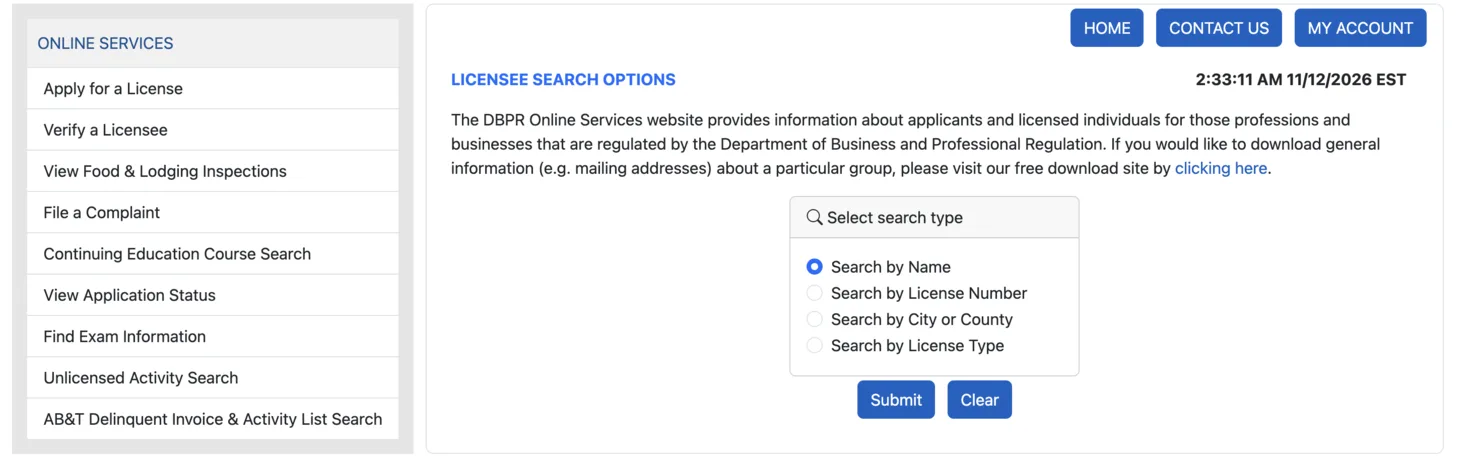
Construction licenses in Florida come from DBPR, the Department of Business and Professional Regulation. Its Verify a Licensee search is free, and searching by number beats searching by name.
The status says whether the license allows work. "Current, Active" and "Probation, Active" mean it does; I explain the full status list here. Working under an inactive or suspended license counts as unlicensed work (F.S. 489.127).
The type must fit your job. Plumbing is CFC or RF, air conditioning is CAC or RA, or a mechanical license, CMC or RM, roofing is CCC or RC, electrical is EC or ER. Electricians sit under a different DBPR board, so a construction-only search won't find them.
Some jobs need no state license at all: drain cleaning, painting, and tile work are examples (F.S. 489.105(3)(m), 489.117(4)(a)1.). For those jobs, neither the state nor a city or county can require a license. Once the job includes repairing or replacing pipes, it is plumbing and needs a licensed plumbing contractor.
Certified or Registered?
A certified license works anywhere in Florida. A registered license works only in the city or county where the contractor met the local competency requirements (F.S. 489.105(8), (10)). If the record says "Registered," confirm that the registration covers the place where your house stands.
Who Qualifies the Company?
The license belongs to a person, called the qualifier, and the company works through that person. In the record, the person sits in the "Name" field as "Primary," the company in "DBA Name," and when the license qualifies a company, search results show two rows with one license number. The company name there should match your quote and contract.
A license can be valid but qualify a different company than the one on your quote. I'd treat that mismatch as a question to ask.
What Shows Up After Probable Cause
A complaint filed with DBPR stays confidential until a review panel finds probable cause, plus 10 more days, or until the licensee gives up confidentiality (F.S. 455.225(10)). So a clean complaint list doesn't mean no complaints were ever filed; you only see cases that reached that stage.
Open each disciplinary document and read the date and the specific violation. DBPR itself warns that the list may be incomplete and points to your local building department.
DBPR also publishes yearly discipline lists as open files, back to the 2021-22 fiscal year: licensed contractors, unlicensed activity, and Recovery Fund claims. Search them for the company name, or the license number in the two lists that have one (Construction Industry Public Records).
During a declared emergency, such as the period after a hurricane, unlicensed work carries heavier penalties, and crews that knock on doors after a storm are the ones to check first (F.S. 489.127, DBPR hurricane season resources).
For checks that go past public records, I keep a separate list.
2. The Business Registration
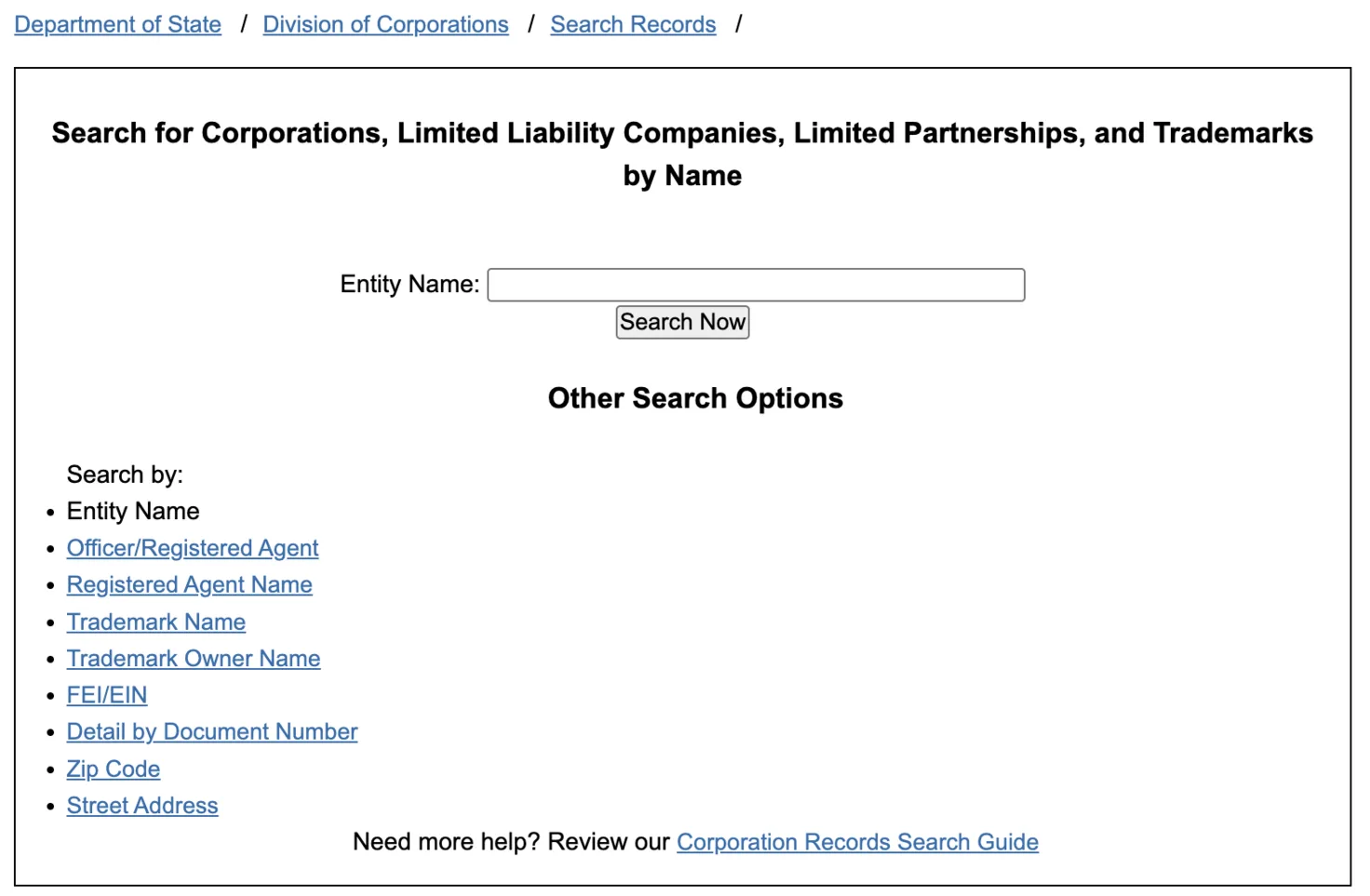
Sunbiz is the state's Division of Corporations. Its free search accepts a company name, document number, officer, or registered agent. When we matched plumbing and septic companies in Tampa Bay by name on September 24, 2026, up to 82% appeared in Sunbiz: 72% as a corporation or LLC and 23% under a fictitious name, with some companies in both.
Is the Company Still Active?
The record shows the entity type, document number, FEI/EIN, dates, status, addresses, registered agent, officers, annual reports by year, and free PDFs of filed documents. Results show a short status such as "Active" or "INACT."
Corporations and LLCs file an annual report between January 1 and May 1. If the report, the fee, or a registered agent is still missing by 5 p.m. Eastern Time on the third Friday of September, the state can dissolve the entity (F.S. 607.1622(4), 605.0212(3), 607.1420(1), 605.0714(1)). If the status reads "Inactive" for that reason, ask before you sign.
The registration date tells you how old the entity is. It says nothing about the crew's experience, and a new entity can belong to an experienced contractor.
The FEI/EIN from this record feeds the next step, because the workers' compensation searches accept it.
Don't expect the qualifier from step 1 to appear as an officer here. A company can hire a licensed qualifier, so the names don't have to match.
Does the Brand Name Match the Entity?
Working under a brand name requires registering it as a fictitious name with the Division of Corporations. That registration runs until December 31 of the fifth year (F.S. 865.09(3), (5)). The fictitious name record lists the brand's owner, and that is how the name from the ad connects to the entity behind the license.
A Sunbiz registration is not a license, and a local business tax receipt is not one either (F.S. 489.127).
3. Workers' Compensation Coverage
In construction, a company needs workers' compensation coverage once it has one employee. Outside construction the threshold is four. A corporate officer who takes pay counts as an employee, and an LLC member with at least a 10% share counts as an officer (F.S. 440.02(20)(b)2, (18)(b), (11)).
If the portal shows neither a policy nor an exemption, ask the contractor who covers the crew; some companies get coverage through an employee leasing company. A construction company with workers and no coverage breaks state law, and I'd treat that as a reason not to hire (F.S. 440.10(1)(a)).
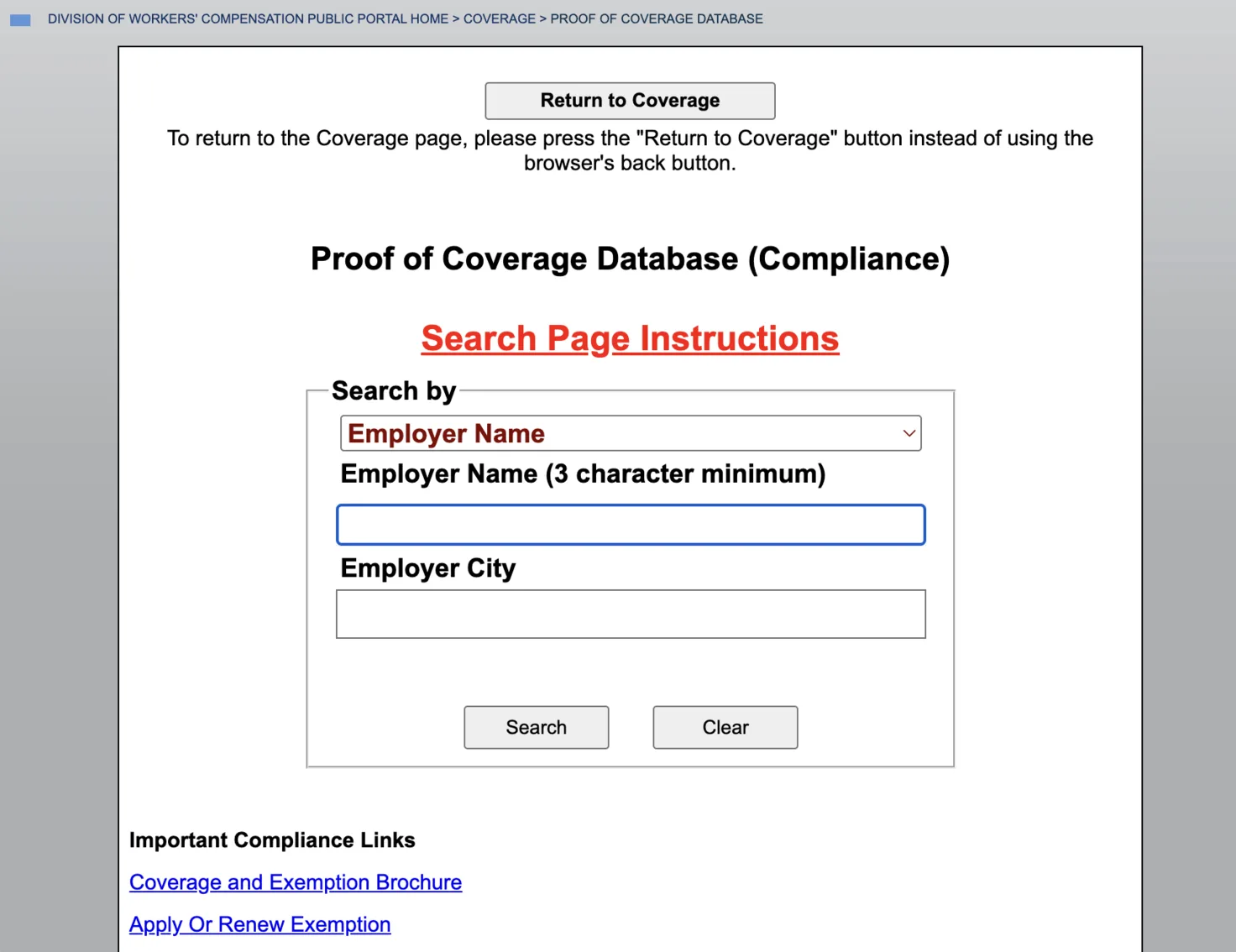
The state runs a free data portal. Proof of Coverage searches by company name, FEIN, or policy number and shows policies from the last 5 years. Exemption Search works by last name, employer, or FEIN, with a "Construction" filter.
Policy, Exemption or Stop-Work Order
An exemption removes one officer from coverage; the company's other workers still need a policy (F.S. 440.05(13)). In construction, no more than three corporate officers may take exemptions, each holding at least a 10% share and listed in Sunbiz. Each certificate runs two years, with both dates printed on it (F.S. 440.02(18)(b)2, 440.05(6)).
Compare the policy or certificate dates with your job dates.
The Department of Financial Services issues stop-work orders to companies without coverage (F.S. 440.107). The public Compliance Stop-Work Order Database searches by employer name, FEIN, or county and dates. It goes back to January 1, 2004 and updates daily, and a company has 21 days to contest an order. An order can be years old and already lifted, so read its date and ask the contractor how it ended.
4. Permits and Inspections
Building permits come from the city or county where your house stands. In Pinellas County, St. Petersburg issues its own permits; the county portal covers unincorporated areas and six smaller towns. A frequent reason for "no permits found" is searching the wrong portal.
The portals search by address, by contractor name, and some by license number. The license number is the most reliable, because names get recorded differently from permit to permit.
In St. Petersburg, 80% of 561 final plumbing inspections passed on the first attempt (October 2026). In four Tampa Bay permit offices, 31% of 491 permits older than one year had expired, and among 11 licenses with 10 or more such permits the share ranged from 0% to 57%. One license accounted for most of the expired permits; without it, 21% had expired. I collected the rest of the permit numbers here.
Reviews don't replace records. In our sample, companies with more than 57 reviews passed the first final inspection in 71% of cases, the others in 84%. That's a correlation in one sample.
Reading a Permit History
Look for recent permits for work like yours, closed permits with a passed final inspection, and a pattern of expired permits or failed finals with no later passed one.
Read with care. The contractor may pull permits in other cities. A new company has few permits. An expired permit can be a cancelled job.
Take the license number from the permit record and compare it with the DBPR record from step 1.
If the contractor asks you to pull the permit yourself as an owner-builder for work their crew will do, stop. An owner who takes out that permit becomes responsible for the work and must personally supervise anything unlicensed people do on the site (F.S. 489.103(7)). A contractor who wants your permit for their work is moving that responsibility onto you.
5. Court Cases and Recorded Liens
Each county's Clerk of Court keeps court cases and official records. For St. Petersburg, that's the Pinellas County Clerk. Court cases sit in Court Records Public View, with no login. Liens and judgments land in the official records, behind a party-name (Grantor/Grantee) search that opens after you accept the terms on the page. If a clerk's staff member runs a name search for you, it costs $7 per name.
Search the legal name, the qualifier, and the officers you found in Sunbiz. The state keeps two more registries that people miss: Judgment Liens, certificates searchable by debtor name, and Federal Lien Registrations, which include tax liens (F.S. 55.202, 55.203, 713.901).
Lawsuits and Judgments
Look for civil suits from customers, judgments against the company, and bankruptcies. A company that has worked for years may have a few suits. Read what each case was about and how it ended, and weigh the pattern against the company's size.
Watch for namesakes and similar names. Compare the address and the officers before counting a case against your contractor.
Bankruptcies and federal cases don't show up at the county clerk. They live in PACER, the federal courts' system; its Case Locator takes a registration. Search pages cost $0.10 each, documents cap at $3, and the fee is waived if your quarterly total stays at $30 or less (how PACER fees work).
Liens on Other Customers' Homes
A claim of lien gets recorded in the official records of the county where the property stands (F.S. 713.08). If suppliers or subcontractors of your contractor recorded liens on other customers' homes, that can mean the contractor isn't paying them, though other causes exist, such as a customer who never paid the contractor. Liens filed by the contractor's subs may be indexed under the sub's and the owner's names, so a search by the contractor's name can miss them. I'd ask about it before signing rather than treat it as a verdict.
For your own project, three documents help protect you: a Notice of Commencement, the notices to owner, and a final payment affidavit before the last check (F.S. 713.13, 713.06(2), (3)(d)). The Florida Attorney General adds one rule of thumb: get lien releases before your final payment.
What the Records Can't Tell You
None of these records measures the quality of the work or the fairness of the price. Star ratings on map listings say little about the records either: of the five-star listings in our sample, many had no active license I could find.
Bonus: County Complaint Search
Some counties publish complaint histories: Pinellas County, Hillsborough County, and Miami-Dade County, which also searches contractors. A complaint doesn't prove guilt. Read how each one closed.
You can also look the company up on the BBB's site yourself. We don't use BBB data, so I leave that check to you.
No Public Search for Liability Insurance
There is no statewide public search for a contractor's liability policy. Ask the contractor's agent for the certificate directly, put yourself on it as the certificate holder, and check the dates and the named insured (New Hampshire Insurance Department explains the risks). The certificate gives you no rights under the policy and shows it only on the day it was issued, so ask the agent to confirm the policy is in force for your job dates. The DBPR license record doesn't show a liability policy.
When a Record Raises a Question
Often the explanation is simple, such as a renamed company or a new LLC for the same crew, so ask first. If the answer doesn't fit the records, I'd find another contractor.
If the explanation points to unlicensed work, you can report it to DBPR (file a complaint). If you've already hired and something went wrong, complain to DBPR, the Florida Attorney General, and FDACS, the state's consumer agency (FDACS complaint page).
Two Florida rules matter once you sign. A contract to repair, improve, or build on your home where labor and materials exceed $2,500 must mention the Florida Homeowners' Construction Recovery Fund, and the fund doesn't cover jobs by unlicensed contractors (F.S. 489.1425, 489.141). If you paid more than 10% up front, the contractor must file for the permit within 30 days of the payment and start work within 90 days of the permit being issued, unless the contractor has just cause or you agreed in writing to a longer period (F.S. 489.126(2)(a)).
How I Put This Together
Most numbers come from published USD.org studies of plumbers in St. Petersburg and Tampa Bay, and each carries the date we collected it. The Sunbiz match in step 2 is an unpublished check of 486 Tampa Bay companies from September 24, 2026. I opened the state, county, and court search pages while writing; Sources lists the dates. The screenshots are scrubbed: names, numbers, and addresses are removed. USD.org is a directory of local service businesses. USD.org is a private company and isn't affiliated with DBPR, DFS, the Division of Corporations, or any county or court.
FAQ
Can I check a Florida contractor for free?
Yes. All five searches are free. You pay for copies, such as $1 per page at the county clerk, and for federal court records in PACER.
What if I can't find the license?
Search by the exact legal name or the license number, and check the type. The work may need no state license, as with drain cleaning. A different DBPR board may hold it, as with electricians. If you still find nothing, ask the contractor for the exact number and name on the license.
Why does the DBPR record show no complaints when I heard about problems?
Complaints stay confidential until a panel finds probable cause, plus 10 days, or until the licensee waives confidentiality. The record shows only cases that reached that stage. Ask your local building department as well.
What does "Inactive" in Sunbiz mean?
It means the entity is no longer active: the state dissolved it, often for a missing annual report, or the owners closed it. The record's filing history shows which. Ask the contractor before you sign.
How do I know the workers are covered?
Search the DFS data portal by company name or FEIN. The policy dates should cover your job. An officer exemption only shows that one officer is excluded; the crew still needs a policy. Then check the stop-work order database.
This article is general information about Florida law, not legal advice. Laws and agency practices change. For a decision about your own project or dispute, check the current law or talk to a Florida-licensed attorney.
If you see an error, especially if you're a licensed contractor, write to [email protected], and I'll check it and correct the article if it's wrong.
Sources
Each source is listed with the date it was last checked.
- USD.org data: 115 plumber listings in and around St. Petersburg, ratings read on October 1, 2026, license file checked on October 26, 2026; 82 plumber websites read on October 1, 2026; Tampa Bay permits collected from city and county portals on October 9-14, 2026; Tampa Bay company names matched against Sunbiz on September 24, 2026.
- Florida Statutes, opened between October 9 and November 12, 2026: F.S. 55.202, F.S. 55.203, F.S. 28.24, F.S. 440.02, F.S. 440.05, F.S. 440.107, F.S. 455.225, F.S. 489.103, F.S. 489.105, F.S. 489.117, F.S. 489.119, F.S. 489.126, F.S. 489.127, F.S. 489.141, F.S. 489.1425, F.S. 605.0212, F.S. 605.0714, F.S. 607.1622, F.S. 607.1420, F.S. 713.06, F.S. 713.08, F.S. 713.13, F.S. 713.135, F.S. 713.901, F.S. 865.09.
- Florida Rule, checked October 21-22, 2026: Rule 61G4-12.011, websites count as advertising.
- Florida DBPR: Verify a Licensee (November 12, 2026), Understanding DBPR Codes (November 12, 2026), Construction Industry Public Records and yearly discipline lists (November 12, 2026), file a complaint (October 27-28, 2026), hurricane season resources, May 2025 (October 9, 2026).
- Florida Department of State, Division of Corporations (Sunbiz), checked November 12, 2026: search records, corporation search.
- Florida Department of Financial Services, Division of Workers' Compensation, checked November 12, 2026: Proof of Coverage, Exemption Search, Compliance Stop-Work Order Database.
- Pinellas County Clerk, checked November 12, 2026: court records public view, official records. Hillsborough County Clerk: records search (October 9, 2026).
- County complaint and contractor searches: Pinellas County (November 12, 2026), Hillsborough County (October 9, 2026), Miami-Dade County (November 12, 2026).
- Permit portals: Pinellas County, how to apply for a building permit (November 12, 2026), Pinellas County Accela (November 12, 2026); the St. Petersburg and Tampa portals are described in our permit study, checked October 13-14, 2026.
- Florida Attorney General: how to protect yourself, contractors (November 12, 2026). FDACS: file a complaint (October 9, 2026).
- Federal courts, checked November 12, 2026: find a case, PACER, how PACER fees work.
- Insurance certificates: New Hampshire Insurance Department, how to verify your contractor's insurance (November 9, 2026; rules written for New Hampshire, used here as general advice).