
Did Your Plumber Pull a Permit? How to Check It and Why It Matters
Your plumber replaced the water heater or repiped the house and told you the permit is "taken care of." You don't have to take that on trust. Permit records are public, and in many places you can look them up online for free.
The short answer:
- Ask the plumber for the permit number before you pay more than the deposit.
- Look the number up on your city's or county's permit portal. Check that the address and the contractor match.
- Before the final payment, make sure the record shows a passed final inspection.
The last step matters a lot. I went through 561 plumbing permits in St. Petersburg, Florida, that reached a final inspection. About 1 in 5 failed the first time and passed only after the plumber fixed something. In a second sample from the Tampa Bay area, the share of a company's plumbing permits that expired ranged from none to more than half.
Most guides stop at "ask for the permit." This one shows you how to read the record, how to check a plumber's permit history before you hire, and what real permit records from Florida say about how often plumbing work passes inspection on the first try.
I'm not a plumber or a lawyer. US Directory doesn't sell permits, plans or plumbing services, and no company paid to be mentioned here.
Does Your Plumbing Job Need a Permit?
Usually yes, if the job adds, replaces or moves pipes, or replaces equipment such as a water heater. Stopping a leak or clearing a clog usually doesn't need one.
Many states and cities build their rules on model codes from the International Code Council. Its residential code lists the plumbing work that doesn't need a permit (International Residential Code, section R105.2):
- stopping a leak in a drain, water or vent pipe;
- clearing a clog;
- repairing a leak in a pipe, valve or fixture;
- taking a toilet off and putting it back.
The exemption doesn't cover repairs that need new parts of the system. If a hidden pipe or trap has to be cut out and replaced, the code treats it as new work. The same goes for replacing or rearranging valves, pipes or fixtures. New work needs a permit and an inspection.
Jobs that usually need a permit:
- replacing a water heater, in many places even with the same type and size;
- repiping all or part of the house;
- replacing the water line from the meter or the sewer line to the street;
- moving or adding fixtures, as in a bathroom remodel;
- any work on gas lines, including a switch to a gas water heater.
Local rules add their own details, so the reliable answer comes from your building department. Call it or check its website, and describe the job in one sentence, for example "replace a 50-gallon electric water heater in the garage."
A burst pipe can't wait for a permit. Codes usually let a plumber make an emergency repair first and apply for the permit right after. If that's your situation, start with What to Do When a Pipe Bursts.
Florida example: plumbing work always needs a permit check
The Florida Building Code uses the same plumbing exemptions as the model code. For an emergency repair, the permit application is due the next working business day (Florida Building Code, Building, sections 105.2 and 105.2.1).
Since July 1, 2026, Florida lets owners of single-family homes ask to skip the building permit for work worth less than $7,500. Plumbing, gas, electrical, mechanical and structural work are excluded from that rule, so a cheap plumbing job doesn't escape the permit (F.S. 553.79(1)(g)).
In unincorporated Pinellas County, licensed contractors can get a quick "Express" permit online for jobs such as a water heater replacement (tank or tankless), interior repiping, an emergency sewer or water service replacement, fixture replacement and a tub-to-shower conversion. Replacing a natural gas water heater or converting to gas is a separate gas permit (Pinellas County Express Permits). The City of St. Petersburg issues its own permits. Its list of work exempt from permits says outright that the plumbing exemption doesn't cover installing or replacing a water heater (City of St. Petersburg, List of Exempted Permits). Its permit records include separate types for water heater change-outs, sewer lateral replacement and the water line from the meter to the house.
Clearing a drain needs no permit, and in Florida it needs no plumbing license either. I explain that in How to Check a Plumber's License in Florida.
Who Should Pull the Permit?
The plumber you hire. A licensed contractor applies for the permit under their own license, and their name goes on the record. The contractor then schedules the inspections and fixes anything that fails.
Some contractors ask the homeowner to take out the permit instead, as an "owner-builder." It sounds like a small favor that saves time. In practice, it moves the responsibility to you. Owner-builder permits are meant for people who do the work themselves. If you sign one and the plumber does the job, in many places the permit makes you, not the plumber, responsible for the work meeting the code. If the worker is unlicensed or uninsured and gets hurt on your property, you may also be liable, and your homeowner's insurance may not cover it.
Treat that request as a warning sign. A plumber who can't pull a permit in your city may not have the license for it. Ask why, and check the license before you go further.
Florida example: what the owner-builder form says
In Florida, an owner-builder must sign a disclosure statement written into state law (F.S. 489.103(7)). By signing it, the owner confirms, among other things, that:
- they must supervise the work on site themselves;
- they may not hire an unlicensed person to act as their contractor;
- unlicensed workers often ask owners to take out an owner-builder permit; if such a worker is injured, the owner may be liable, and homeowner's insurance may not cover it;
- if they sell or rent the house within 1 year after the work, the law presumes it was built for sale, which breaks the exemption.
The same law covers contractors. A Florida contractor may not let anyone else use their license number, and may pull a permit only for a job they have a contract for (F.S. 489.127(4)). Starting work that needs a permit without one in effect is prohibited (F.S. 489.127(1)(h)). For a licensed contractor, it's also a ground for discipline (F.S. 489.129(1)(o)).
How to Check
1. Get the permit number. Ask the plumber for it before the work starts, or at least before you pay more than the deposit. A plumber who pulled a permit has the number and can send it in a minute. The permit or a copy should also stay on site until the job is done (International Residential Code, section R105.7).
2. Find out who issues permits for your address. Permits are local. Inside city limits, the city's building department usually issues them. Outside, it's usually the county. A common reason people can't find a permit is searching the wrong office. Your county property appraiser's or assessor's website usually shows whether your address is inside a city.
3. Search the portal. Many building departments have an online permit search. You can usually search by:
- permit number, the fastest way to a single record;
- address, which lists every permit at the property;
- contractor name or license number, which lists the plumber's other jobs.
If an address search finds nothing, try just the house number and street name.
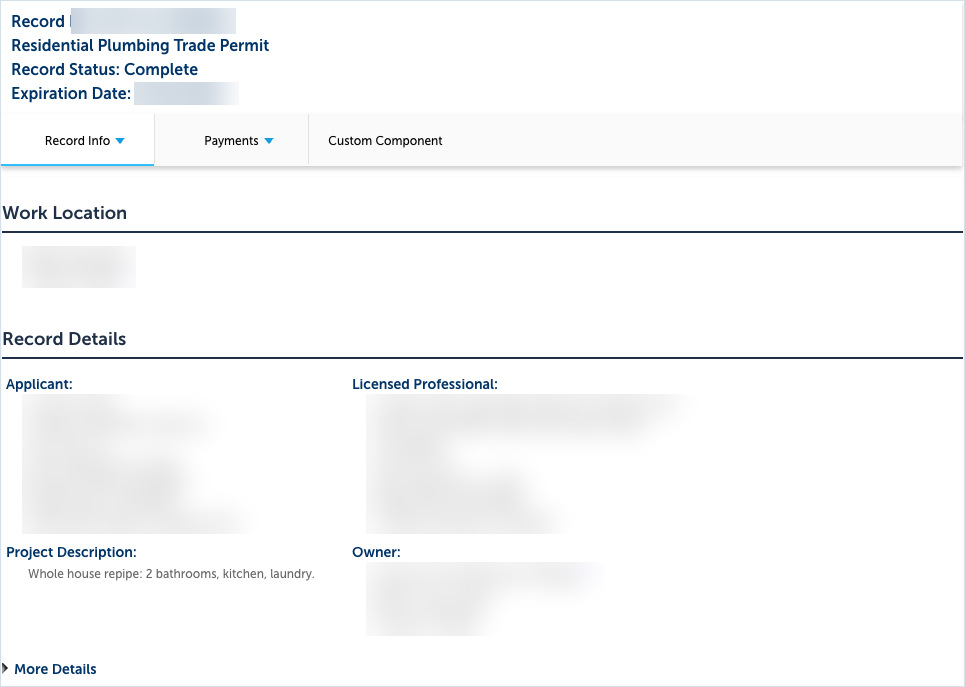
4. Check that the record matches your job.
- The address is yours.
- The contractor is the company you hired, with its license number.
- The description matches the work, for example a water heater change-out and not a smaller job.
- The permit was issued before the work started.
5. No portal? Call or ask in writing. Call the building department and give your address. Staff can usually tell you what's on file. If you need copies, ask for the records in writing.
Florida example: neighbors, different portals
Around St. Petersburg, the address decides where you look. The City of St. Petersburg issues its own permits. Its online search, "Online Permits & Status," is linked from the city's Building Permits page. Pinellas County issues permits for unincorporated areas and for Belleair Beach, Belleair Shore, Indian Rocks Beach, Kenneth City, Safety Harbor and Oldsmar, through its Access Portal. The county's permitting guide explains how to check which office serves your address. Across the bay, the City of Tampa and Hillsborough County each run their own portal.
Florida's public records law lets anyone inspect and copy the records of a government office, including a building department (F.S. 119.07(1)(a)). The right belongs to any person, not just the owner.
How to Read a Permit Record
Two parts of the record matter: the permit's status and its list of inspections. Portals word them differently, but the statuses fall into a few groups.
| What you may see | What it means | What to do |
|---|---|---|
| Submitted, In Review, Pending | The plumber applied, but the permit isn't issued yet. | Outside an emergency, the work shouldn't start yet. |
| Issued, Approved, Active | The work is allowed. Inspections are still ahead. | Ask which inspections are planned and when. |
| Disapproved, Failed, Correction Notice, Partial Approval (on an inspection) | The inspector found something to fix. | Ask what failed and when the re-inspection is, before you make the final payment. |
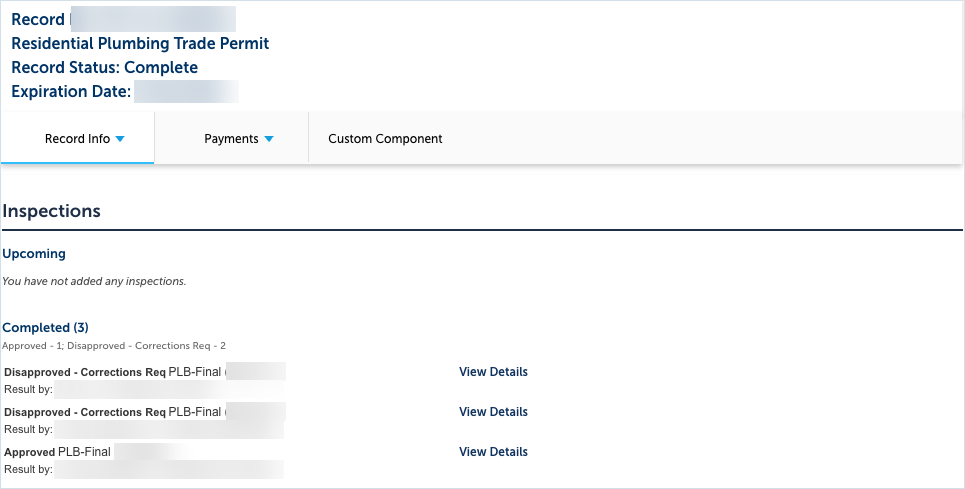
| Finaled, Complete, Closed | The permit is finished. | Open the inspection list and confirm the final inspection was approved. |
| Expired | Time ran out before the permit was closed. | Ask the plumber to renew it and finish the inspections. |
| Withdrawn, Void, Cancelled, Revoked | The permit no longer covers the work. | If the work was done, no permit covers it. Ask why. |
"Closed" usually means the final inspection passed, but not always. Some offices close old permits without one, so check the inspection list rather than the status alone.
Bigger jobs are inspected in stages. The model code calls for a rough inspection of the plumbing before pipes are covered or fixtures are set, and a final inspection when the work is complete (International Residential Code, section R109.1). A simple job, such as a water heater swap, may have only one inspection.
A failed inspection isn't a disaster. It means the inspector caught a problem before it was hidden behind a wall. What matters is that the record ends with an approved final.
Florida example: how long a permit lasts and how it gets closed
Since July 1, 2026, a permit for a single-family home expires 1 year after it's issued, or when the next edition of the Florida Building Code takes effect, whichever is later. The local office can extend it (F.S. 553.79(1)(c)).
An expired permit isn't a dead end. If the work is substantially complete, the office can close it without a new permit. It can also close a permit 6 years after it was issued, even without a final inspection, if it sees no apparent safety hazard (F.S. 553.79(16)).
Florida also lets the owner, or the contractor with the owner's written permission, hire a private provider for inspections instead of the city or county (F.S. 553.791(2)(a)). In that case the record may show "Private Provider Inspection" where you'd expect an inspector's result.
Why It Matters
Safety. Building codes set the minimum requirements for a safe home (International Residential Code, section R101.3). An inspector checks what you can't easily check yourself, such as gas connections and pipes before the walls are closed.
Fixing it later costs more. If work starts before the permit is issued, the model code lets the local office charge an extra fee on top of the regular permit fee (same code, section R108.6). To approve work after the fact, the inspector has to see it, and that may mean opening a finished wall or floor.
Selling the house. Buyers and their agents can look up the same records you can. An open permit, or work that should have had one, can turn into a repair request or a lower offer.
The warranty. Manufacturers tie warranties to proper installation. For example, the A. O. Smith warranty for the electric tankless water heater models it lists applies only when the heater is installed and operated in line with local fire and plumbing codes, ordinances and regulations (A. O. Smith, Tankless Electric Water Heater Warranty). A passed inspection is the clearest record that it was.
Insurance. If you have plumbing work that was never permitted, ask your agent how your policy treats it before you need to file a claim.
Florida example: an open permit stays with the owner and the contractor
In Florida, a city or county may not refuse a permit to a new owner, or fine them, only because a previous owner's permit was never closed. The office keeps all its rights against the property owner and the contractor listed on that permit (F.S. 553.79(17)). If you plan to sell, close your open permits first.
What Permit Records Show: Our Numbers
I looked at two sets of public permit records for the plumbing companies in our St. Petersburg directory. I don't name the companies here.
St. Petersburg. For each of 82 companies, I took up to 25 of its most recent completed permit applications from the city's portal, in October 2026. 561 of those permits had a final plumbing inspection with a result. I picked completed applications, so nearly all of them, 556 (99%), passed in the end. The number that tells you more is the first try:
- 446 (80%) passed on the first try;
- 30 needed three or more tries, and one needed six.
Among the 24 companies with at least 10 final inspections, the first-try pass rate ranged from 58% to 100%.
Tampa Bay counties. In four permit offices (the City of Tampa and Hillsborough, Pasco and unincorporated Pinellas counties), I found 858 plumbing permits pulled under 37 of these companies' licenses between September 25, 2024, and September 24, 2026.
- Of the 491 permits more than a year old, 58% were finished, 31% had expired, 9% were withdrawn or void, and 3% were still open.
- One license accounted for 90 of the 150 expired permits; expired permits can also mean cancelled jobs. Without it, 21% had expired.
- Among the 11 company licenses with at least 10 such permits, the share that expired ranged from 0% to 57%.
- Of the finished permits with a final plumbing inspection on record, 78% passed it on the first try.
What this means for you:
- A finished permit almost always has a passed final on record, so if yours doesn't, ask.
- A failed first inspection is common. What matters is that the problem gets fixed and the final passes.
- Companies differ a lot in how they see permits through, so check a plumber's permit history before you hire (next section).
The numbers have limits:
- A permit stays with the office that issued it. A company can do much of its work in places these offices don't cover, so a small count doesn't mean little work.
- The city portal lists contractors by name, not by license number, so a few permits may be missing or assigned to the wrong company.
- An expired permit doesn't always mean bad work. The customer may have cancelled the job.
- Most of these permits were issued before Florida changed how long permits last, on July 1, 2026.
Check a Plumber's Permit History Before You Hire
The same portals work in the other direction. Before you hire, search by the plumber's company name or, better, by license number. You'll see the jobs they pulled permits for and how those permits ended.
What to look for:
- recent permits for jobs like yours, such as water heaters, repiping or sewer lines;
- finished permits with an approved final inspection;
- warning signs: many expired permits, or finals that failed and never passed.
Read the results with care:
- Search every spelling of the company name. On the St. Petersburg portal, one company in our sample appears under three different names.
- A plumber may work mostly in other cities or counties, so a short list in one portal proves little.
- A new company has few permits. That's not a bad sign on its own.
The permit record also shows the license number of the contractor who pulled it. Check that number against your state's license search, the way I describe in Why We Show License Numbers, Not Just "Licensed" Badges.
Florida example: matching the permit to the license
On the Tampa and county portals, a plumbing permit lists the "Licensed Professional" with a state license number, such as CFC for a certified plumbing contractor. Look that number up in the state license search at myfloridalicense.com. The license should be active and belong to the company you hired. How to Check a Plumber's License in Florida explains what each license type means.
If Your Plumber Didn't Pull a Permit
What to do depends on how far the job has gone.
The work hasn't started. Don't let it start until the permit is issued. Ask for the permit number in writing before the work starts.
The work is under way. Ask the plumber to stop and apply for the permit now. It's the cheapest moment to fix the problem, because the inspector can still see the work. Remember that the office may charge an extra fee for work that started early. Agree in writing on who pays it.
The work is done. Write to the plumber and ask them to get the permit and pass the inspections. Keep copies of the contract, invoices, photos and messages. If the plumber refuses or has disappeared, call your building department and ask how to permit the work after the fact. You may need another licensed plumber to finish the paperwork and fix what the inspector finds.
If you believe the plumber broke the rules, you can file a complaint with your state or local contractor licensing office. Some licensing boards can order a contractor to repay you; others can't. For anything beyond that, money disputes go to court, and for that you need a lawyer.
Florida example: closing a permit and filing a complaint
In Florida, a property owner can close an open permit even if someone else applied for it. The owner can keep the original contractor or hire a different licensed one. A new contractor is liable only for their own work, not for the defects of the first one (F.S. 553.79(16)(a)).
In Pinellas County, complaints against contractors go to the county's Contractor Licensing Department (Submit a Complaint against a Contractor). For a state-certified contractor, the county's instructions also suggest a complaint to the Florida Department of Business and Professional Regulation. The same instructions say the county can't make a contractor return money or pay compensation (complaint form and instructions). The state board can require financial restitution to a consumer as part of discipline (F.S. 489.129(1)).
This is not legal advice
This guide explains how permits generally work. It isn't legal advice. Rules differ by state, county and city, and they change. For a dispute with a contractor, talk to a licensed attorney in your state.
What to Put in Writing Before Work Starts
Put these points in the contract or an email:
- Who pulls the permit. Normally the plumber does, under the license number written in the contract.
- When you get the permit number. The answer should be "before the work starts."
- Which inspections the job needs, who schedules them, and who lets the inspector in.
- Who pays the permit fee and any fees for repeat inspections.
- That the final payment is due after the final inspection passes.
- That you get a copy of the permit record once the permit is closed.
Florida example: license numbers and the Notice of Commencement
A Florida contractor must put their license number on every permit application and on every bid, contract and advertisement (F.S. 489.119(5)). If the contract has no number, ask for it.
For a job with a contract over $5,000, a copy of the recorded Notice of Commencement must be filed with the permit office before the first inspection (F.S. 713.135(1)). The notice is recorded with the county clerk and posted at the job site. The statute's own warning says payments made after the notice expires can make you pay twice for the same work (F.S. 713.13).
FAQ
Do I need a permit to replace a water heater?
In many places, yes, even for a same-size swap. St. Petersburg says so outright, and unincorporated Pinellas County issues a quick online permit for it. Check with your building department (Does Your Plumbing Job Need a Permit?).
Do I need a permit to replace a toilet or a faucet?
It depends on the place. The model code doesn't require a permit to take a toilet off and put it back. Replacing the fixture itself is treated differently from place to place: St. Petersburg exempts a swap in the same location if no pipes or valves change, while unincorporated Pinellas County lists fixture replacement among its permits.
Can I pull the permit myself and hire a plumber to do the work?
Owner-builder permits are meant for owners who do the work themselves. If a plumber does the job under your permit, you become responsible for the work meeting the code (Who Should Pull the Permit?).
Can I look up permits for a house I'm buying?
Yes. Permit records are public, so you can search by address on the local portal or ask the building department (How to Check). In Florida, the city or county can't refuse you a permit or fine you only because a previous owner's permit was never closed. It's still worth asking the seller to close it.
How long does a permit last?
It depends on the local code. The model code voids a permit if the work doesn't start within 180 days, or if more than 180 days pass between inspections (International Residential Code, section R105.5). Since July 1, 2026, a Florida permit for a single-family home lasts at least 1 year from issue, and the office can extend it.
My plumber says I don't need a permit. What should I do?
Ask which exemption applies, then check it with your building department. If a permit is required and the plumber still refuses to pull one, look for another plumber.
This article is general information, not legal advice for your situation. Codes and local rules differ from place to place and change over time. Where your building department's rules differ from this guide, follow theirs. See also our Terms.
Spotted a mistake, or know a better way to check a permit? I welcome feedback and corrections, and I especially want to hear from licensed plumbers and building officials. Email me at [email protected].
Sources
All sources checked on October 15, 2026. US Directory has no financial relationship with any company or organization mentioned here.
- International Code Council: 2024 International Residential Code, Chapter 1: Scope and Administration (R101.3, R105.2, R105.5, R105.7, R108.6, R109.1).
- International Code Council: Florida Building Code, Building, 8th Edition (2023), Chapter 1 (105.2, 105.2.1).
- Florida Statutes 2026: 553.79, 553.791, 489.103, 489.119, 489.127, 489.129, 713.13, 713.135, 119.07.
- Pinellas County: Express Permits.
- Pinellas County: Permitting Guide.
- Pinellas County: Submit a Complaint against a Contractor.
- Pinellas County Construction Licensing Board: Complaint form and instructions.
- City of St. Petersburg: Building Permits.
- City of St. Petersburg: List of Exempted Permits.
- A. O. Smith: Tankless Electric Water Heater Warranty.
- Florida DBPR: License search.
- Permit and inspection records: City of St. Petersburg permit portal (Click2Gov), collected October 13-14, 2026; Accela Citizen Access portals of the City of Tampa and Hillsborough, Pasco and Pinellas counties, collected October 9-13, 2026. Screenshots: Hillsborough County HillsGovHub, October 15, 2026, personal details blurred.