
How to Check a Plumber's License in Florida
Florida requires a license to work as a plumbing contractor. A company needs a state license, either certified (CFC, valid statewide) or registered (RF, valid only where it was issued) (F.S. 489.113(2), 489.105). You can check any license for free in the state's online search at myfloridalicense.com. A few jobs don't need one: Florida sets no licensing requirement for drain cleaning (F.S. 489.105(3)(m)), and casual, minor jobs under $2,500 are exempt (F.S. 489.103(9)).
Below, I show where to search and what each part of the record means.
The Short Version
- Ask the company for its license number. For plumbing, it starts with CFC or RF.
- Search the number in the state's Verify a Licensee tool.
- Check that the status reads "Current, Active" or "Probation, Active."
- Check that the company name on the record matches the name on your quote.
If the search finds nothing, don't rule the company out yet. The steps below explain why that happens and what to try.
The St. Petersburg numbers in this article come from US Directory, which I founded to rank local service businesses using an open methodology. We read the websites of 82 local plumbing companies and matched each one to the state's license file by license number or name. Where that failed, we also checked fictitious business names registered with Sunbiz and phone numbers on license applications.
Where to Check: Two Official Tools
You don't need a third-party site to check a plumber. Two free state tools cover almost every case.
| Tool | Run by | What it covers | When to use it |
|---|---|---|---|
| Verify a Licensee | Florida DBPR | All state licenses, including certified (CFC) and registered (RF) plumbing contractors | First, for every plumber |
| Unlicensed Activity Search | Florida DBPR | Public complaints against people or businesses that were not licensed at the time | When you suspect a company has no license |
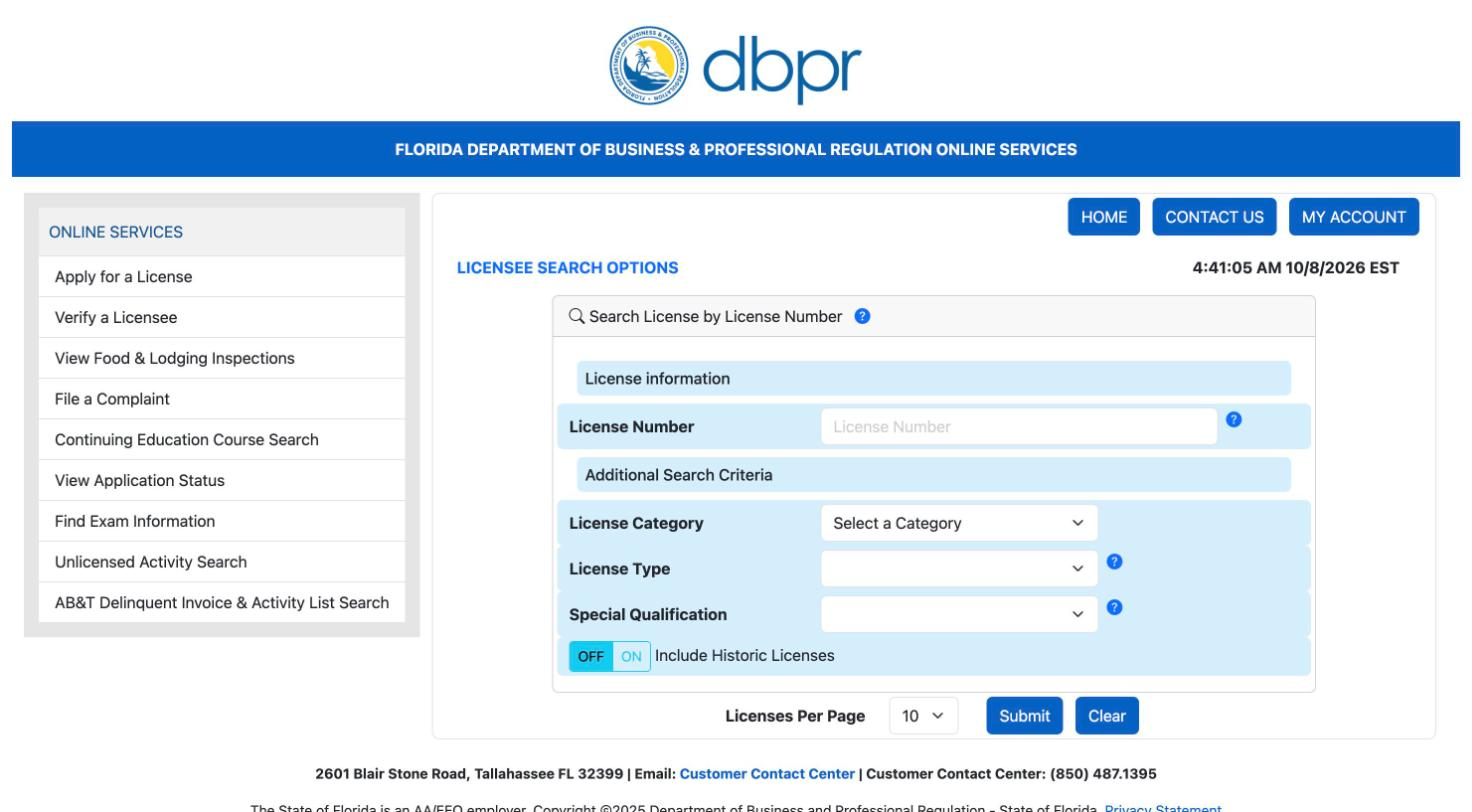
I always start with the state search. DBPR has two entry pages for it, "License Search" and "Verify a Licensee." Both offer the same four search options: by name, license number, city or county, and license type.
The Unlicensed Activity Search works differently. It lists public complaints against people and businesses that had no DBPR license when the complaint was filed. You can narrow it by county, but then it shows only those whose address of record is in that county. A company based elsewhere won't appear, so search by name.
Your county's licensing board, such as Pinellas County's Contractor Search, is for journeymen and for trades the county licenses itself. To find yours, search your county's official website for "contractor licensing." Pinellas County, for example, says state-certified contractors no longer need to register with the county and should be checked with DBPR.
Searching DBPR Step by Step
The state search gives you more than a yes or no. Here is how I run it, and what I look at on each screen.
Search by License Number
This is the fastest way, if the company gives you a number.
- Open Verify a Licensee.
- Choose "Search by License Number" and click Submit.
- Type the number exactly as written, for example CFC1234567, and click Submit.
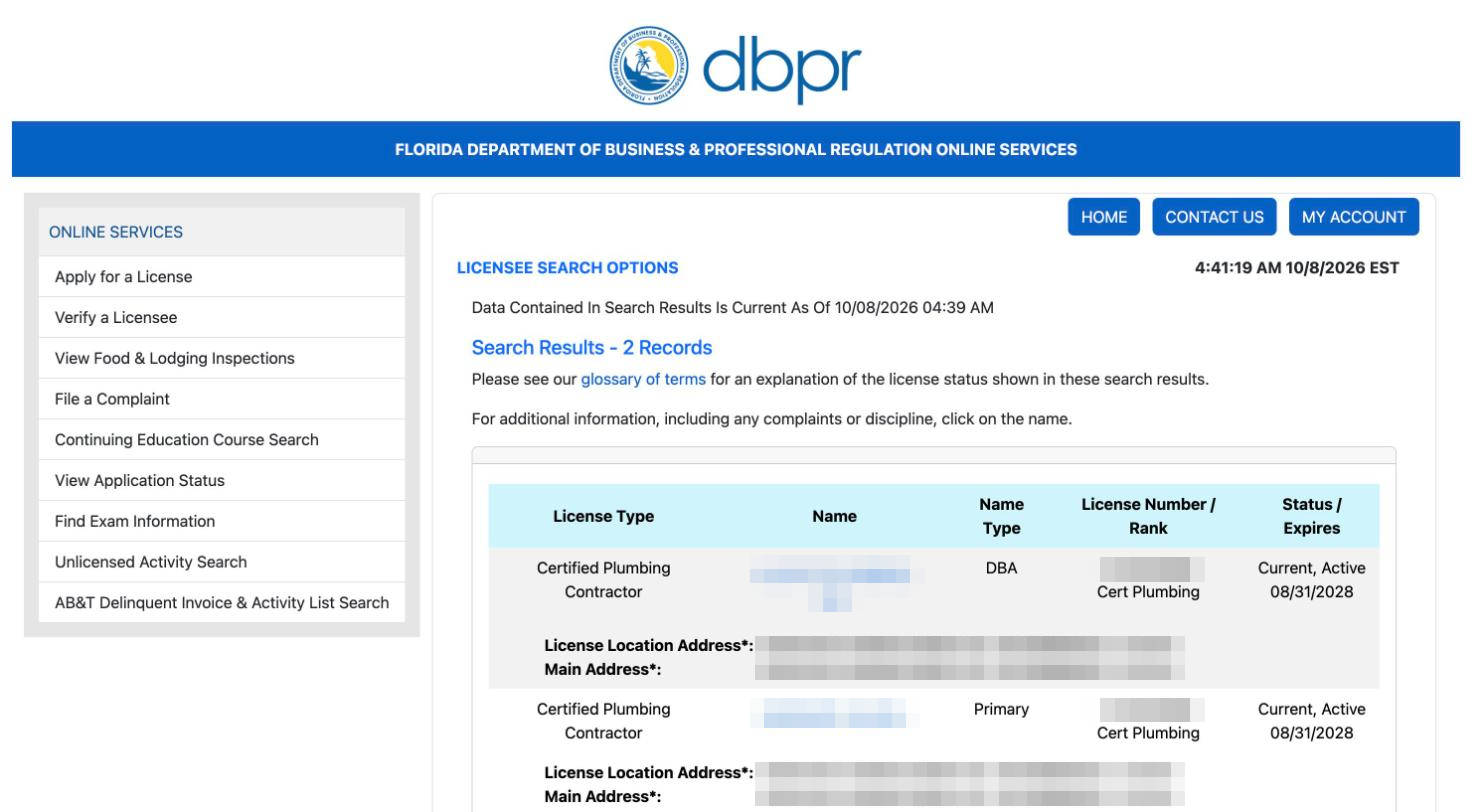
One license can show up as two rows with the same number. One row is the company, marked "DBA" in the Name Type column. The other is the person who qualifies the company, marked "Primary." Both should show the same status.
Search by Company Name
If you only have a name, choose "Search by Name" and type it in the "Organization/Establishment Name" field. You can skip apostrophes: "Allens Plumbing" also finds "Allen's Plumbing."
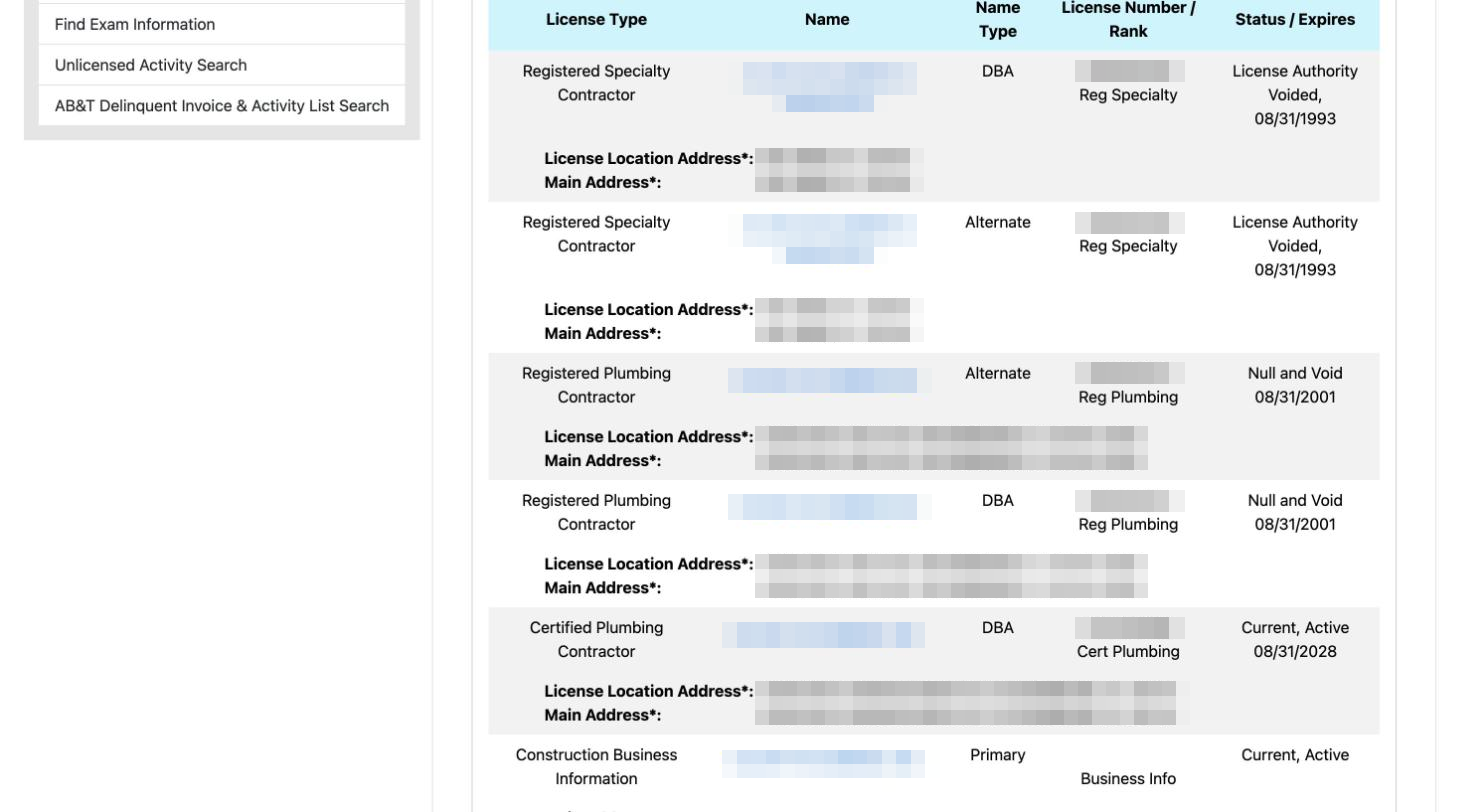
A name search can return more than you expect. When I searched for one St. Petersburg plumber, I got six records. Two were another company with a similar name in another city, whose license was voided in 1993. Two were the same plumber's old registered license, which expired in 2001 and is now marked "Null and Void." One was the current certified license, and the last was the company's business record, not a license. Check the city and the status before you trust a row.
Search by the Qualifier's Name
You can also search for the person behind the license, using the last and first name fields. This helps when the company works under a name that differs from its license.
Open the Full Record
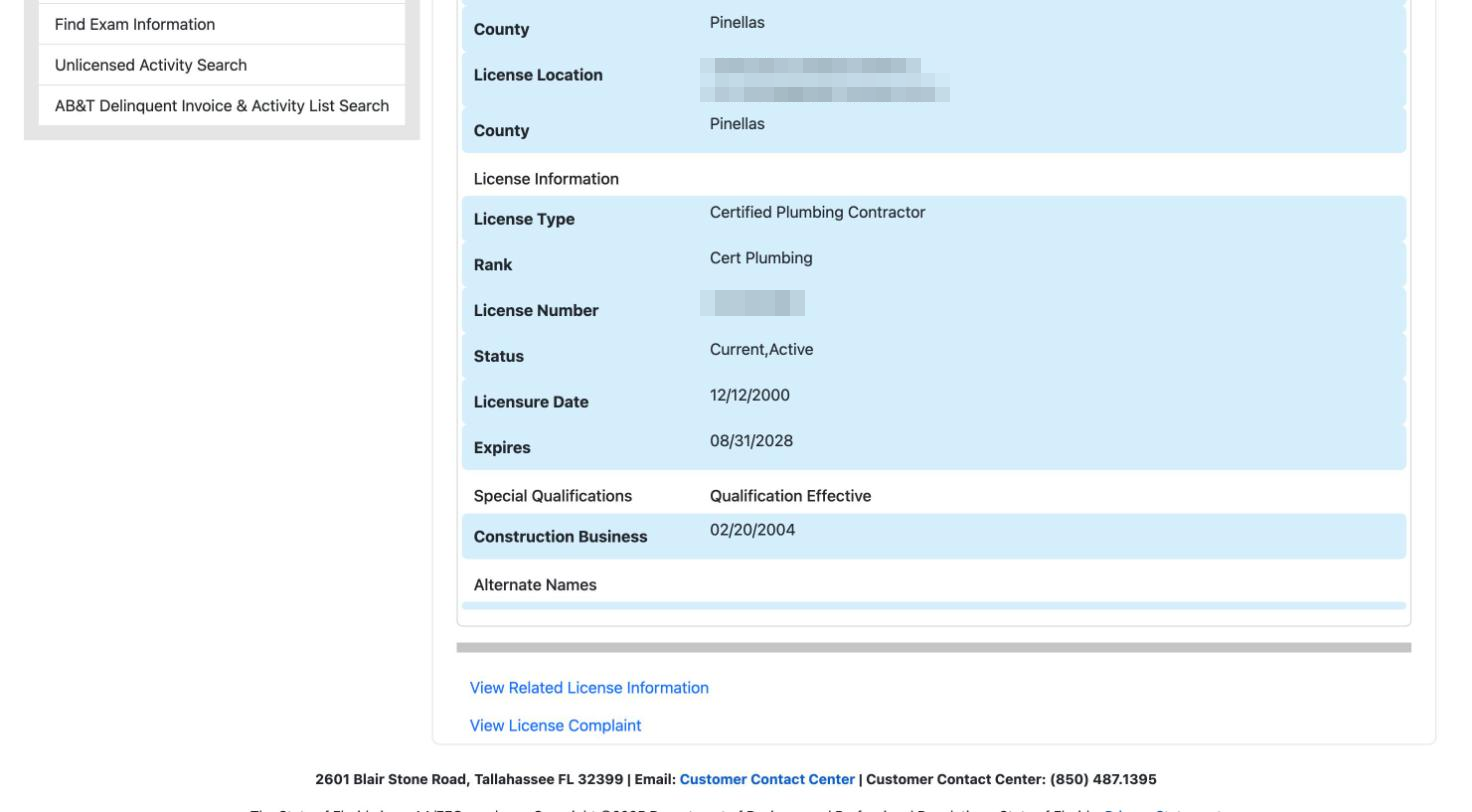
Click a name in the results to open the license details. That page shows:
- the person's name and the company name (DBA);
- the business address and county;
- the license type, rank, and number;
- the status, the date first licensed, and the expiration date;
- a "View License Complaint" link with the public complaint history.
What Each License Status Means
The status column has two parts, such as "Current, Active." The first part says where the license stands with the state. The second says whether the holder may work under it. DBPR's glossary defines "Active" as allowed to operate under the license, and "Inactive" as meeting the requirements but not allowed to work under it.
So a contractor may work only when the status reads "Current, Active" or "Probation, Active." This applies to certified (CFC) and registered (RF) licenses alike. Anything else, including "Current, Inactive," means no.
| First part of the status | What DBPR says it means | With "Active," can they work? |
|---|---|---|
| Current | Up to date with the state's requirements | Yes |
| Probation | On probation as part of a disciplinary action or as a condition of licensure | Yes, but check the complaint history |
| Delinquent, Invol. Inactive, or Lic Expired | Did not renew on time | No |
| Suspended | Work privileges suspended for a set period | No |
| Revoked | No longer meets the requirements to hold the license | No |
| Null and Void | Failed to renew several times and must reapply | No |
| License Authority Voided | The license was cancelled | No |
| Vol. Relinquish, Retired, or Deceased | The holder gave up the license, retired, or died | No |
Florida law backs this up. Working on an inactive or suspended license counts as working without a license (F.S. 489.127(1)).
A status is only as fresh as the search. DBPR prints the time of its data at the top of every results page, for example "Data Contained In Search Results Is Current As Of 10/08/2026 04:39 AM." If a job starts weeks after you checked, check again.
Certified, Registered, and County Licenses
The letters at the start of a license number tell you where the contractor may work.
- Certified (CFC for plumbing). The contractor qualified for state certification, usually by passing the state exam, and may work anywhere in Florida (F.S. 489.105(8), 489.111, 489.115).
- Registered (RF for plumbing). The contractor met a local competency requirement and may work only in that area (F.S. 489.105(10)).
For air conditioning, the same pair is CAC and RA.
Most plumbers you'll meet hold a certified license. Statewide, DBPR's license file lists 7,986 certified plumbing contractors with a "Current, Active" status and 552 registered ones. In our St. Petersburg data, 69 of the 71 companies with an active license held a certified one, and only 2 a registered one.
If your plumber's license starts with RF, ask where the registration is valid, then confirm with your city or county building department. A registered license from another county doesn't cover your job.
Some counties also certify contractors in a wide range of trades. Pinellas County's licensing board, for example, keeps its own list of county-certified contractors. For plumbing contracting itself, a county card isn't enough: the company must also be registered (RF) or certified (CFC) with the state, so it should show up in DBPR (F.S. 489.117(1)).
Who Actually Holds the License
In Florida, a company doesn't get a license on its own. A person applies for the license as the company's qualifying agent and holds it for the business (F.S. 489.119(2)). By law, that person supervises the company's operations, its field work at every site, and its finances (F.S. 489.1195).
That's the person in the "Primary" row of the search results.
Before you sign, I'd check three names against each other:
- The company name on the quote or contract.
- The company name (DBA) on the DBPR record for the license number.
- The qualifier's name on the same record.
If the first two don't match, ask why. Often the answer is a fictitious name. Florida requires a business that uses a name other than its legal name to register it with the state (F.S. 865.09), and Sunbiz's fictitious name search shows who owns it. In our St. Petersburg data, one company's website showed a license number that DBPR lists under a different company. Sunbiz showed that the website's name is a registered fictitious name of that company. But a number can also belong to someone else entirely, so get an answer before you sign.
One person can also qualify more than one business, with the licensing board's approval (F.S. 489.119). In our data, four pairs of companies shared a qualifier. That can be legitimate, such as two brands of one owner. But two "different" plumbers may turn out to be the same people.
A state business registration on Sunbiz is not a license either. It shows that a company exists, not that it may do plumbing. Neither is a local business tax receipt, the yearly fee a city or county charges to do business there (F.S. 205.022, 205.053). Florida law says plainly that it is not a contractor's license (F.S. 489.127(1)).
When the Search Says "Not Found"
An empty search doesn't always mean an unlicensed plumber. More often, the search didn't match the way the license is written. Before you rule a company out, go through these steps.
License not found? Seven checks before you rule a company out
Empty searches often come from how the name or license is written, not from a missing license.
- Search lessDrop “Inc.” or “LLC,” skip apostrophes, try one or two key words.
- Search by numberOld and void licenses show up with their status. Nothing? Turn on “Include Historic Licenses.”
- Search by personAsk for the qualifier’s name and search by it.
- Ask for the legal nameBrands and franchise locations may hold the license under another name. Sunbiz's fictitious name search shows who owns a brand name.
- Check whether the job needs this licenseDrain cleaning needs none. Septic contractors register with the Florida Department of Environmental Protection, not DBPR.
- Check the county for journeymen and local tradesA plumbing company still needs a state license that DBPR shows.
- Still nothing? Ask for the numberNo number, no hire for work that needs a license.
Sources: Florida DBPR license search; F.S. 489.105(3)(m), 489.117(1), 489.551, 489.553; Florida Department of Environmental Protection, septic tank contractor registration.
Here is what this looked like in our St. Petersburg data. Of 82 local plumbing companies, we found an active license for 71. For four of them, the license turned up only through a fictitious name registered with Sunbiz or a phone number on a license application. For the other 11, their own websites explain much of the gap:
- 5 mainly do work outside a plumbing license: appliance repair, landscaping, water filters, septic service, or sewer camera inspection.
- 6 present themselves as plumbing or HVAC companies but showed no license number, and we found no active license under their names.
11 St. Petersburg companies with no active license found
Grouped by what each company’s own website says it does. Only the second group is a real question mark.
- 1. Mainly work outside a plumbing license: 5
- 2. Plumbing or HVAC company, no number, no active license found: 6
Source: US Directory, 82 local plumbing companies in St. Petersburg, websites read October 8, 2026; matched to Florida DBPR and Sunbiz records October 9, 2026.
Only that last group of six is a real question mark. Even then, the answer may be a legal name we didn't know.
Complaints and Discipline
A current license tells you the company may work. It doesn't tell you how past customers fared. For that, check three places.
Complaints on the DBPR Record
On the license details page, click "View License Complaint." Each complaint shows a number, the incident date, a status, and a disposition, meaning how it ended.
Read the disposition, not just the count. When I tested the search, the record I opened had one complaint from 2008. It was closed as "Insufficient Evidence to Prosecute." A complaint on the list is not proof of wrongdoing.
The list is also incomplete by design. A complaint against a licensee stays confidential until 10 days after probable cause is found, and DBPR notes it can't show complaints that the law keeps confidential (F.S. 455.225). DBPR also suggests calling your local building department to ask about disciplinary actions that could affect your project.
State and County Consumer Offices
Anywhere in Florida, you can turn to the Department of Agriculture and Consumer Services. It calls itself "the state's clearinghouse for consumer complaints" and says it can help "regardless of whether we regulate the specific industry." Call 1-800-HELP-FLA (435-7352) or file a complaint online.
Some counties also take consumer complaints about any business, licensed or not. Pinellas and Hillsborough, for example, let you search their complaint records online. To find your county's office, search its official website for "consumer protection."
The Better Business Bureau
BBB profiles show complaints and how the business responded. They're useful, but keep a few things in mind:
- It's not a government agency. The BBB says it "holds no regulatory power" and "cannot force a business to act."
- Its letter grade is an opinion. BBB calls a rating its "opinion of how a business is likely to interact with its customers." The grade leans heavily on complaints: unanswered complaints alone can cost up to 40 of 100 points. Customer reviews don't count toward it (BBB).
- Accreditation is voluntary and paid. The BBB says accreditation is separate from the rating.
- It isn't a license check. BBB lowers a rating when it knows a business lacks a required license, but it doesn't look the license up for you. An A+ doesn't tell you the license is current.
On a BBB profile, I look at three things: how many complaints there are compared with the size of the company, whether the business answered them, and whether the same problem keeps coming up.
A grade you can't check is hard to trust. That's why I think business ratings should be open, and why we publish the principles behind our own rating.
Before You Sign
A license check is the start. Before you sign a quote, I'd confirm four more things.
- The number is on the contract. Florida requires the license number on every offer, bid, and contract (F.S. 489.119(5)(b)). It should match the number you checked.
- Who pulls the permit. Most plumbing installations and replacements need a permit. Small repairs, such as clearing a stoppage or fixing a leak without replacing pipes, don't (Florida Building Code, 2023 edition, section 105.2). Ask who will apply for the permit, then look it up in your city's or county's permit search.
-
Proof of insurance. Ask for a certificate of insurance and call the insurer to confirm the policy is still active. A license only shows that the contractor swore to having insurance when the license was issued or renewed.
Check workers' compensation too. In construction, Florida requires it for a business with even one employee (F.S. 440.02(20)(b)). Up to three corporate officers who each own at least 10 percent may exempt themselves, but only by filing with the state (F.S. 440.02(18)(b)). You can look up both in the state's free Proof of Coverage and Exemption searches. It matters to you: Florida's owner-builder disclosure, which homeowners sign to pull their own permits, warns that if an unlicensed contractor or their worker is hurt on your property, you may be held liable (F.S. 489.103(7)).
-
The deposit. If you pay more than 10 percent up front for work on your home, Florida law requires the contractor to apply for permits within 30 days and to start work within 90 days after the permits are issued, unless it has just cause or you agree in writing to longer periods (F.S. 489.126(2)).
If a job goes badly, the license also decides whether the state can help you get money back. I explain how Florida's recovery fund works in my article on license numbers.
After a Storm
After a hurricane, you may get repair offers at your door. Some of these crews come from other states: DBPR lists "unmarked vehicles with out-of-state plates" among the warning signs of unlicensed activity. Check them the same way, and with more care.
It happens here. After Hurricanes Helene and Milton, DBPR and the Pinellas County Sheriff's Office made more than 50 arrests. The people arrested had asked homeowners to pay for 85 projects, including plumbing. DBPR says the operation saved homeowners from more than $250,000 in scams (DBPR, November 2024).
Florida treats unlicensed work more harshly at these times. Normally it is a first-degree misdemeanor, but while a state of emergency declared by the Governor is in effect, it is a third-degree felony (F.S. 489.127(2)(a), (c)).
Before you agree to storm repairs:
- Ask for the license number and check it in the state search before any money changes hands.
- Keep the deposit small. DBPR names large upfront cash payments as a warning sign, and the 10 percent rule above applies (F.S. 489.126(2)).
- Be wary if the contractor won't pull permits or asks you to pull them yourself. DBPR lists that as a warning sign too.
- Don't sign on the spot. A licensed contractor will still be there tomorrow.
If You Already Hired an Unlicensed Contractor
Again, this is general information, not legal advice. If money or an injury is involved, talk to a Florida-licensed attorney before you act.
Florida law still gives you some protection, though less than with a licensed contractor.
- The contractor can't enforce the contract. A contract made by an unlicensed contractor is "unenforceable in law or in equity by the unlicensed contractor" (F.S. 489.128(1)). The law looks at whether the contractor had the license on the date of the contract.
- The contractor can't put a lien on your home, but others still might. An unlicensed contractor has no lien rights. Its unpaid subcontractors and suppliers may keep theirs (F.S. 489.128(2), (3); 713.02(7)).
- Damages can be tripled. If you sue over injuries caused by the contractor's negligence or misconduct, the law entitles you to three times your actual damages, plus costs and attorney's fees, when the contractor has neither a state certification nor a local license (F.S. 768.0425).
- The state may not be able to help with money. Florida's owner-builder disclosure warns that DBPR "may be unable to assist you with any financial loss" and that "your only remedy against an unlicensed contractor may be in civil court" (F.S. 489.103(7)). The recovery fund pays only for violations by licensed contractors (F.S. 489.141(1)(c)).
What to do now:
- Keep the contract, receipts, messages, and photos of the work.
- Report the contractor to DBPR's unlicensed activity line at 1-866-532-1440, or file a complaint online.
- Before you pay more or stop the work, get legal advice.
If you'd like to suggest a correction or an addition to this guide, email me at [email protected].
FAQ
Does Florida require plumbers to be licensed?
Yes. A company that does plumbing work in Florida needs a certified (CFC) or registered (RF) license (F.S. 489.113(2)). Workers can do the job under a licensed contractor's supervision. Drain cleaning alone needs no license (F.S. 489.105(3)(m)).
How do I check a plumber's license in Florida?
Use the state's free online search on myfloridalicense.com. A license number gives the fastest and most exact result; a company name works too but brings up extra records. On the record, look at three things: the status, the company name, and the person who qualifies the company.
What does CFC mean on a license?
CFC is the code DBPR uses for a certified plumbing contractor, licensed to work anywhere in Florida. RF is a registered plumbing contractor, limited to the area where the registration was issued.
Which license status means a plumber can work?
Only two: "Current, Active" and "Probation, Active." Any other status, including an inactive or suspended license, means the contractor may not work under it, and Florida law treats work on such a license as unlicensed (F.S. 489.127(1)).
The search can't find my plumber. Are they unlicensed?
Not necessarily. Empty searches often come from how the name was typed, a brand name that differs from the licensed company, or a license held by the company's qualifier. Try a shorter name, the license number, and the qualifier's name, and look the brand up in Sunbiz's fictitious name search. If the company still can't give you a number that checks out, don't hire it for licensed work.
Why is there a different name on the license?
In Florida, a company works under the license of a qualifying agent, the person responsible for its work and finances. So the record shows both the company and that person. If the company on your quote doesn't match the company on the record, ask why before you sign.
Is a business tax receipt or a Sunbiz registration a license?
No. Sunbiz only shows that a company is registered with the state, and a local business tax receipt is a yearly fee for doing business in a city or county. Neither one allows a company to work as a plumbing contractor.
Can a handyman do plumbing in Florida?
Only small jobs. Florida exempts casual, minor work that costs less than $2,500 in total and isn't part of a larger project. The exemption doesn't cover anyone who advertises as a contractor (F.S. 489.103(9)). If you're not sure a job qualifies, ask your building department before work starts.
Does Florida have a journeyman plumber license?
Not at the state level. Some counties, such as Pinellas, certify journeymen. You can't hire a journeyman directly: Pinellas County's licensing board says journeymen are a contractor's employees and must work under a licensed contractor's supervision.
Does a plumbing company need workers' compensation insurance?
In construction, yes, as soon as it has one employee. Some owners may exempt themselves by filing with the state. You can check both coverage and exemptions for free in the Division of Workers' Compensation searches.
Where can I see complaints about a plumber?
Start with the complaint history on the DBPR license record, but keep in mind that recent complaints stay confidential while they're investigated. Then check the state consumer office (FDACS), your county's consumer protection office, and the BBB, which is a private organization whose grade is its own opinion.
What should I watch for after a hurricane?
Door-to-door crews, demands for large cash deposits, and contractors who won't pull permits. Check the license before you pay anything. During a declared state of emergency, contracting without a license is a felony in Florida.
What if I already hired an unlicensed plumber?
The contractor can't enforce the contract against you and has no lien rights, but its unpaid subcontractors and suppliers might. The state recovery fund won't cover your loss. Keep your records, report the contractor, and talk to a Florida-licensed attorney before you pay more or stop the work.
How do I report an unlicensed contractor?
Call DBPR's toll-free unlicensed activity line at 1-866-532-1440, or file a complaint online. In Pinellas County, you can also call the county licensing board at (727) 582-6767.
This article is general information about Florida law, not legal advice. Laws and agency practices change. For a decision about your own project or dispute, check the current law or talk to a Florida-licensed attorney.
Sources
All sources checked on October 9, 2026.
- Florida Statutes: F.S. 205.022, F.S. 205.053, F.S. 440.02, F.S. 455.225, F.S. 489.103, F.S. 489.105, F.S. 489.111, F.S. 489.113, F.S. 489.115, F.S. 489.117, F.S. 489.119, F.S. 489.1195, F.S. 489.126, F.S. 489.127, F.S. 489.128, F.S. 489.141, F.S. 489.551, F.S. 489.553, F.S. 713.02, F.S. 768.0425, F.S. 865.09.
- Florida Building Code, Building, 2023 (8th edition): section 105.2, work exempt from permit.
- Florida DBPR: Verify a Licensee, glossary of license terms, Unlicensed Activity Search, contact us, hurricane season resources, May 2025, unlicensed contractors after Hurricanes Helene and Milton, November 2024.
- Pinellas County Construction Licensing Board: Contractor Search.
- Florida Department of Agriculture and Consumer Services: Division of Consumer Services, file a complaint.
- Florida Department of State, Division of Corporations (Sunbiz): fictitious name search.
- County complaint searches: Pinellas County, Hillsborough County.
- Florida Department of Financial Services, Division of Workers' Compensation: Proof of Coverage search, Exemption search.
- Florida Department of Environmental Protection: septic tank contractor registration.
- Better Business Bureau: overview of ratings, FAQ.
- US Directory data: 82 local plumbing companies in St. Petersburg, websites read on October 8, 2026, and matched to Florida DBPR and Sunbiz records on October 9, 2026; statewide license counts from the Florida DBPR license file downloaded on October 2, 2026.