
What to Do When a Pipe Bursts: A Step-by-Step Guide
If water is pouring out of a pipe right now, close your home's main water valve first, if you can reach it without walking through water near outlets, cords or the electrical panel. Everything else can wait a few minutes.
Water damage, including burst pipes, is one of the most common ways a home gets damaged. About 1 in 60 insured homes files a claim for water damage or freezing every year, second only to wind and hail, and from 2019 through 2023 the average claim was $15,400, according to the Insurance Information Institute.
This guide takes you through what to do, in the order that matters: stop the water, make the room safe, protect the water heater, get help, record the damage, dry out and call your insurer. It works for houses and apartments anywhere in the U.S. Where Florida is different, I say so: many homes there have no basement, and the main valve is often outside.
I run US Directory, which ranks local service businesses using an open methodology. I'm not a plumber. Where official guidance exists, I follow it and link to it, and I list every source at the end.
If water is coming out right now
- Close the main water valve, if you can reach it without walking through water near outlets, cords or the electrical panel. A lever handle needs a quarter turn, until it sits across the pipe. A round handle turns clockwise until it stops. Can't find the valve? See where to look.
- Stay out of any room where water reaches outlets, cords or the electrical panel. Switch off the breakers only if the floor, the panel and your hands are dry. If you're unsure, don't touch it: call an electrician or your electric utility.
- Turn off the water heater. Switch off its breaker if it's electric, or turn the gas control to "Off".
- Open the lowest cold-water faucet to drain what's left in the pipes and take pressure off the break.
- Call a licensed plumber, and tell them the water is already off.
If you smell gas, leave the house and call 911 from outside. If anyone is hurt, or you see sparks or smoke, call 911.
Step 1: Shut Off the Water
Close the main valve first, even if the leak looks small, as long as you can reach it without walking through water near electricity.
Where to Find the Main Water Valve
The model building code that most states base their rules on requires a main shut-off valve near the point where the water line enters the home (International Residential Code, P2903.9.1). So start by finding where the pipe comes in. That depends on how the house is built:
- With a basement: on the wall that faces the street, where the pipe comes through the foundation, often next to the water meter.
- With a crawl space: near the spot where the line comes through the foundation.
- On a concrete slab, with no basement: in the garage, the laundry room, next to the water heater, or outside, low on the wall that faces the street.
If you still can't see it, find your water meter. In warm climates it's usually in a box in the ground near the street or the sidewalk; in cold climates it's often in the basement. If the meter is outside, picture a straight line from it to the house: the valve is usually somewhere along that line.
How to Close It
- Lever handle (ball valve): give it a quarter turn, until the lever sits across the pipe.
- Round handle (gate or globe valve): turn it clockwise until it stops. That can take several turns.
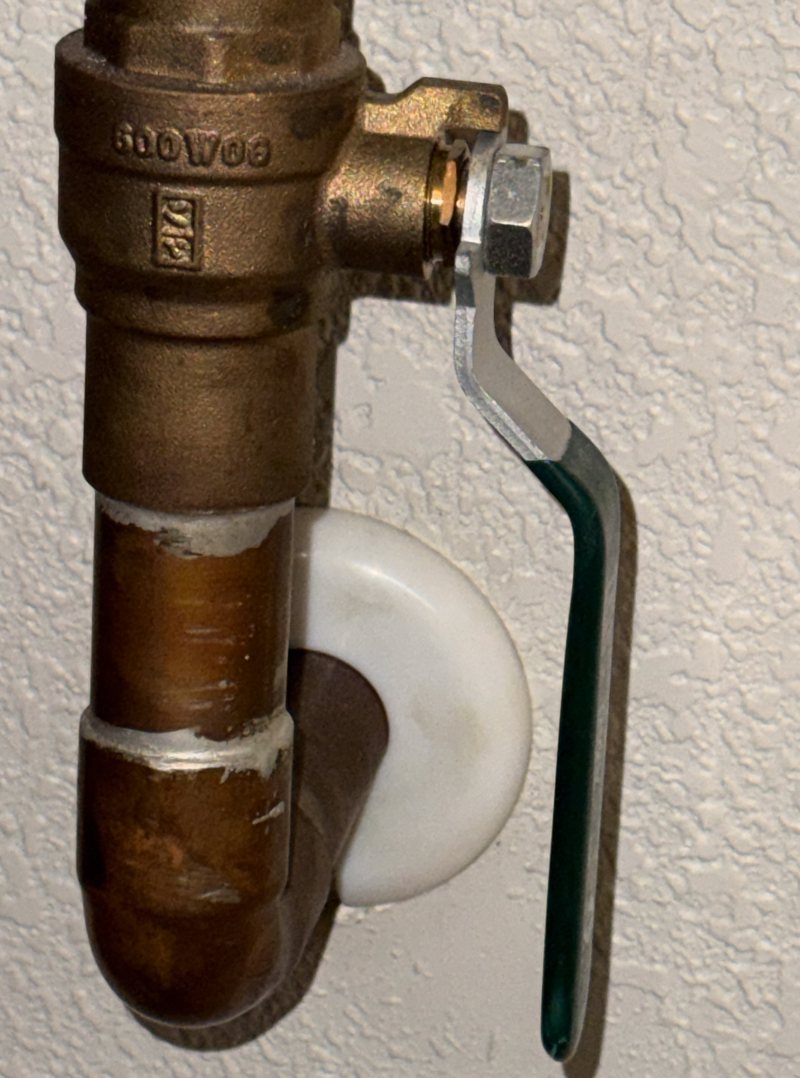
Then open a faucet. If the water slows to a trickle and stops, the valve is closed.
If the Valve Won't Turn or You Can't Find It
- Don't force it. An old valve that hasn't moved in years can break under a long wrench and make the leak worse.
- Look for a closer valve. If the water comes from one sink, toilet or appliance, you may be able to stop it there (see below).
- Call your water utility. Most utilities can shut off the water at the meter, and many run an emergency line. Many don't allow customers to operate the valve in the meter box, so call them instead of turning it yourself.
When the Leak Is at One Fixture
The same code requires a shut-off valve on the supply line to each sink, toilet and appliance, though not to tubs and showers, and one on the cold-water line to the water heater (P2903.9.2 and P2903.9.3). If water is coming from a hose under a sink, behind a toilet or behind the washing machine, turn that small valve clockwise. The rest of the house keeps its water. Older homes may not have these valves.
In an Apartment or Condo
- Look for a valve for your unit: near the water heater, in a utility closet, under the kitchen sink or behind an access panel.
- If there isn't one, call maintenance or the management's emergency line right away. The valve for the whole building may be in a locked room you can't reach.
- Warn your downstairs neighbors. Water runs down through the floor, and they may see it before you do.
- Tell your landlord or association in writing, by text or email, with the time. You'll want that record later.
Florida example: the valve is usually outside
Few Florida homes have a basement, so the main valve is usually outside. The City of Tampa says it's typically on the side of the house, low to the ground and sometimes behind bushes, between the meter box and the home. Pinellas County Utilities says most homes it serves have the valve outside, and some have it in the garage.
Don't use the valve inside the meter box unless your utility allows it. Tampa's city code makes it unlawful to turn the water on or off at the curb stop yourself, and the Pinellas County Utilities policy manual reserves the valve at the meter box for the utility. If your own valve fails, call the utility and ask for an emergency turn-off. Tampa notes that a fee may apply.
Step 2: Make the Room Safe
Once the water is off, the danger isn't over. A burst pipe can leave live electricity in a wet room, a ceiling heavy with water and, if a drain line broke, sewage on the floor. Deal with these before you start cleaning. If you can't make the room safe, leave the house and call for help.
Electricity
- Stay out of any room where water covers outlets or cords or reaches the electrical panel. The New Jersey Department of Health gives similar advice for floods.
- Switch off the power only if the floor, the panel and your hands are dry. Then turn off the breakers for the wet rooms, or the main breaker. If you'd have to stand in water to reach the panel, or you're unsure, don't touch it. Call an electrician instead, as the CDC advises, or your electric utility.
- Don't touch electrical equipment that's wet, or anything electrical while you're standing in water (Ready.gov).
- Don't use anything that got wet, whether it's a ceiling light, an outlet, an extension cord or an appliance, until an electrician has checked it.
Ceilings and Walls
If a ceiling bulges, sags or drips, stay out from under it and keep everyone out of the room. Drywall soaked with water is heavy and can come down without warning. Don't switch on a ceiling light that has water near it.
Gas
If you smell gas, the rotten-egg smell, leave the house right away. Don't flip light switches, start appliances or make calls inside: a spark can ignite the gas. Call 911 or your gas company once you're outside (National Fuel Gas). If a gas water heater sat in water, don't use it: A. O. Smith's gas water heater manual says a flooded unit must be replaced, not repaired. Have a gas furnace that got wet checked before you turn it back on.
Clean Water or Sewage
A burst supply pipe sends out ordinary tap water. A broken drain or sewer line, or water rising from a toilet, tub or floor drain, can carry sewage. A bad smell or dark, cloudy water are the usual signs.
If sewage may be involved:
- wear rubber boots, rubber gloves and goggles if you have to go in (CDC);
- leave the cleanup to a professional, and tell the plumber when you call.
Who Should Stay Away
People with asthma, other lung conditions or a weakened immune system shouldn't go into a home with a water leak or mold they can see or smell (Ready.gov). Keep children and pets away until the cleanup is done, as the CDC advises.
Step 3: Drain the Pipes and Turn Off the Water Heater
Closing the main valve stops new water from coming in, but the pipes are still full. Draining them takes the pressure off the break and leaves less water to leak out.
Drain the Lines
- Open the cold-water tap at the lowest point in the house: a basement or laundry sink, a ground-floor tub or an outside hose faucet. Let it run until it stops.
- Open a tap on the top floor as well. Air comes in from above, and the water drains faster below.
- Watch the low tap. A steady stream that doesn't let up after the pipes should have emptied means water is still coming in, and the main valve isn't fully closed.
In an apartment, opening your own taps is enough.
Turn Off the Water Heater
With the supply off, the tank can't refill. If it loses water through a leak, you don't want it heating a tank that's running low.
- Electric: switch off the water heater's breaker, but only if the floor, the panel and your hands are dry (see Step 2). A. O. Smith's manual for one of its residential electric models warns that powering the heater before the tank is completely full may burn out the upper heating element.
- Gas: turn the gas control knob to "OFF", as A. O. Smith's gas water heater manual describes.
- Tankless: follow the shutdown steps in its manual.
- If the leak is at the water heater itself: close the valve on the cold-water pipe that feeds it. Building codes require one at or near the heater (P2903.9.2, see Step 1).
- If the water heater stood in water: don't use it, and have a professional check it. A. O. Smith's gas water heater manual says a flooded unit must be replaced (see Step 2).
When the Water Comes Back On
After the repair, the plumber will refill the pipes. Don't turn the water heater back on until its tank is full. A. O. Smith's manual for its electric model says to open a hot-water tap and let it run in a full, steady stream for three minutes first. Then switch the breaker back on, or relight the gas heater by following the lighting instructions on its label, or ask the plumber to do it.
Step 4: Call a Plumber You Can Trust
Once the water is off and the room is safe, you don't have to rush. Take a few minutes to find the right plumber.
What to Tell the Plumber
- Whether the water is off. If you couldn't shut it off, say so first: that makes it an emergency.
- Where the break is, and whether it's on a hot or a cold line, if you know.
- What the pipe looks like: copper, plastic or old gray steel. If you're not sure, offer to send a photo.
- What the water reached: outlets, the electrical panel, a ceiling or the water heater.
- How long it leaked before you found it.
What to Ask Before They Come
- Is there a service-call fee, and does it count toward the repair?
- Do you charge more at night or on weekends? If the water is off and the room is safe, the repair may be able to wait for regular hours.
- Do you charge a flat price or by the hour?
- What's your license number?
- When can you get here?
- Do you also remove water and dry out the room, or will I need a separate company for that? (More on drying in Step 6.)
Check the License
Most states and some localities require plumbers to be licensed, according to the U.S. Bureau of Labor Statistics. The Federal Trade Commission advises checking a contractor's license with your state or county government and asking for proof of insurance. Look the license up on your state licensing board's website, and make sure it's active and in the name of the company you called.
In Florida, a contractor's license number has to appear in every offer, bid, contract and advertisement, so an ad without one is a reason to ask. My guide on how to check a plumber's license in Florida walks through the state's free search.
Red Flags
The FTC lists these signs of a home improvement scam:
- someone knocks on your door because they're "in the area";
- they press you to decide right now;
- they want the whole price up front, or only cash;
- they ask you to get the building permits yourself;
- they suggest a lender they know.
Don't pay in cash, and don't pay the full price until the work is done.
Step 5: Record the Damage Before You Clean
Your insurer will want to see what the water did. Record it before you mop, move or throw anything away.
Photos and Video
- Walk through every wet room with your phone's video on: floors, walls, ceilings, cabinets, furniture and anything that was sitting on the floor. The National Association of Insurance Commissioners (NAIC) advises taking photos or video and listing the damage.
- Photograph the break itself, close up and from a few steps back, and any water marks on the walls.
- Don't edit the photos. Your phone records the date and time of each one.
A List of Damaged Items
Write down each damaged item with its brand, model and rough age, and what you paid if you remember. Florida's Department of Financial Services suggests a list with product details.
Keep What Got Damaged
- Don't throw damaged things away yet. The NAIC suggests that you save damaged items, if you can, so the insurer can inspect them.
- The exception is anything that's a health risk, such as food or things soaked with sewage. Photograph it, then get rid of it. Florida's guide makes the same exception.
- Ask the plumber to leave you the broken piece of pipe or the failed hose. It shows what broke and why.
Repairs: Stop the Damage, Then Wait
- Do what it takes to stop more damage: fix the pipe, remove the water, dry the room. Insurers generally expect this. Keep every receipt, and take photos before and after (NAIC, Florida DFS).
- Hold off on rebuilding, such as new flooring or new drywall, until the insurer's adjuster has seen the damage or told you to go ahead. If the adjuster is slow and waiting would cause more damage, tell your insurer in writing, then do what's needed and keep records.
Keep a Call Log
Note every call with your insurer, the plumber and any cleanup company: the date, the time, who you spoke with, what they said and your claim number.
Step 6: Remove the Water and Dry Out
Know What Kind of Water You Have
The restoration industry's standard, IICRC S500, sorts water damage into three categories:
- Clean water (Category 1): from a broken supply pipe, like most burst pipes.
- Gray water (Category 2): from a washing machine, a dishwasher or an overflowing toilet without sewage.
- Black water (Category 3): sewage, or water that comes up from a drain.
The steps below are for clean water. The EPA's drying guidelines cover only clean water too. For gray or black water, call a professional (see Step 2).
You Have About 24 to 48 Hours
The EPA says that if wet materials are dried within 24 to 48 hours, in most cases mold won't grow. So start as soon as the room is safe and the damage is recorded.
- Remove standing water with a mop, towels or a wet/dry vacuum. Don't use a household vacuum: it isn't made for water.
- Move furniture and rugs out of the wet room. If something is too heavy, lift it off the wet floor.
- Run fans and a dehumidifier, and keep the air conditioning on. The EPA recommends indoor humidity below 60 percent, ideally 30 to 50 percent.
- Open windows only if the air outside is drier than inside. In hot, humid weather, keep them closed and let the air conditioner and dehumidifier do the work.
What You Can Dry and What Has to Go
The EPA's table for water-damaged materials gives a starting point:
| Material | What the EPA recommends within 24 to 48 hours |
|---|---|
| Carpet | Remove the water with an extraction vacuum, then dry it with a dehumidifier and fans |
| Drywall | Can dry in place if it isn't swollen and the seams are intact; otherwise replace it |
| Ceiling tiles | Throw away and replace |
| Insulation | Throw away and replace |
| Upholstered furniture | Extract the water and dry it; it may be hard to dry within 48 hours |
| Wood | Remove the moisture right away; use dehumidifiers, gentle heat and fans |
| Hard surfaces | Wipe with water and a mild detergent, then let them dry |
| Books and papers | Throw away what you don't need; copy important papers, or freeze them until they can be dried |
When to Call a Water Damage Company
Call a professional if:
- water got inside walls, ceilings or under the floor;
- more than one room is wet, or you can't get things dry within two days;
- the water was gray or black;
- mold covers more than about 10 square feet. Below that, the EPA says you can usually clean it yourself.
The IICRC lists certified companies in its online locator. The same checks from Step 4 apply: the license, the questions about price, and no full payment up front. In Florida, removing more than 10 square feet of mold is mold remediation under state law, and a company you hire to do it needs a state mold remediator license.
Step 7: Call Your Insurance Company
Call your insurer the same day if you can. Most insurance companies have a time limit for reporting a claim, according to the NAIC. Tell them what happened and when, and what you've done to stop the damage. Write down your claim number and the name of your adjuster.
What's Usually Covered
Every policy is different, but Washington State's Office of the Insurance Commissioner describes the usual pattern:
- Sudden leaks are usually covered, including burst pipes and frozen pipes, if you heat your home properly.
- Gradual leaks usually aren't, such as a dripping faucet or water seeping through a foundation.
- Waiting can cost you. Insurance may not cover water damage if you delay repairs.
- Mold usually isn't covered, unless it comes from water damage the policy covers.
If you rent, your landlord's insurance doesn't cover the things you own. Your own renters policy may. In a condo, the association's policy and yours may each cover part of the damage, so call both.
Before You Sign Anything
Cleanup and repair companies sometimes arrive with paperwork about your insurance claim. Read it before you sign. Florida's Department of Financial Services suggests calling your insurer before you sign any repair contract, in case your policy has its own repair program or preferred companies, and reading carefully any contract that charges a percentage of your insurance payment.
In Florida
- Deadlines for you: notice of a claim has to reach your insurer within 1 year after the date of loss, and a supplemental claim within 18 months. That's the outer legal limit. Most policies require prompt notice, so report right away.
- Deadlines for the insurer: for most policies, the state's guide says the insurer should acknowledge your claim within 7 days and send you a Homeowner Claims Bill of Rights, and pay or deny the undisputed part within 60 days. If you disagree, the Department of Financial Services offers free mediation.
- No handing over your claim: for policies issued on or after January 1, 2023, you can't assign your insurance benefits to a contractor. Any such assignment is void.
This section is general information, not legal advice. Your policy and your insurer decide what's covered. If you're in a dispute, talk to your state's insurance department or a licensed attorney.
Why Pipes Burst
- Freezing. Water expands as it freezes, and the pressure can split a pipe. The pipes most at risk, according to the American Red Cross, run along exterior walls, come in through the foundation, or sit in unheated spaces such as a garage, an attic, a crawl space or a cabinet under a sink.
- Too much water pressure. The model building code caps household water pressure at 80 psi and requires a pressure-reducing valve where the street pressure is higher (P2903.3.2). A plumber can check yours with a gauge.
- Worn appliance hoses. Rubber supply hoses to a washing machine, a dishwasher or a toilet crack with age.
- An aging water heater. The tank and its connections wear out over time.
- Old or corroded pipes.
In warm states like Florida, where pipes rarely freeze, the other causes on this list matter more.
Get Ready Before It Happens
- Find your main valve today. Label it, show everyone in the house where it is, and turn it once a year so it doesn't seize.
- Save two numbers in your phone: your water utility's emergency line and a licensed plumber you've already checked.
- Replace appliance hoses. The Insurance Institute for Business & Home Safety (IBHS) suggests replacing washing machine hoses every 3 to 5 years with braided stainless steel ones.
- Look after the water heater. IBHS suggests flushing the tank twice a year, having the anode rod inspected every 2 years and replacing the unit every 7 to 10 years, depending on your water and how much you use.
- Prepare for cold snaps. The Red Cross suggests keeping the heat at 55°F or higher when you're away, letting cold water drip from faucets on exposed pipes, opening cabinet doors under sinks and insulating pipes in unheated spaces. If a pipe does freeze, the Red Cross suggests thawing it with a hair dryer, a heating pad or towels soaked in hot water, never with a blowtorch, a kerosene or propane heater, or any open flame. Keep electrical devices away from standing water.
- Consider leak sensors or an automatic shut-off valve. IBHS describes whole-home systems that watch the water flow and close the main valve when they detect a leak. Ask your insurer whether it offers a discount for one.
- Before a long trip, turn off the main valve and the water heater.
- Check your insurance now, not after a leak: what water damage it covers, your deductible and, if you rent, whether you have renters insurance.
FAQ
How long does it take for a burst pipe to cause mold?
In most cases mold won't grow if wet materials are dried within 24 to 48 hours, the EPA says. Start drying as soon as the room is safe (Step 6).
Should I turn off the electricity when a pipe bursts?
Only if water is near outlets, cords or the panel, and only if the floor, the panel and your hands are dry. Otherwise call an electrician or your electric utility (Step 2).
Who pays when a pipe bursts in an apartment or condo?
It depends on where the leak started and whose policy covers what. Your landlord's insurance doesn't cover your belongings, and in a condo you should call both the association and your own insurer (Step 7).
Can I stay in my home after a pipe bursts?
It depends on the damage. If you have any doubt about the electricity, the ceiling, gas or sewage, or if someone in the home has asthma, another lung condition or a weakened immune system, stay somewhere else until a professional has checked (Step 2).
Does homeowners insurance cover a burst pipe?
Usually, if the leak was sudden; slow leaks and delayed repairs usually aren't covered, and your policy decides. In Florida, the law sets an outer limit of 1 year to report a claim, but most policies require prompt notice (Step 7).
How do I find an emergency plumber I can trust?
Check the license on your state licensing board's website and ask about fees on the phone. Walk away from anyone who wants cash only or full payment up front (Step 4).
This article is general information, not legal, insurance or professional advice for your situation. Codes, policies and utility rules differ from place to place. Where your utility, your insurer or a manufacturer's instructions differ from this guide, follow theirs. If you're unsure whether something is safe, stop and call a professional. See also our Terms.
Spotted a mistake, or know a better way to handle any of these steps? I welcome feedback and corrections, and I especially want to hear from licensed plumbers. Email me at [email protected].
Sources
All sources checked on October 13, 2026. US Directory has no financial relationship with any company or organization mentioned here.
- Insurance Information Institute: Facts + Statistics: Homeowners and renters insurance.
- International Code Council: 2021 International Residential Code, Chapter 29: Water Supply and Distribution (P2903.3.2, P2903.9.1-P2903.9.3).
- City of Tampa: Water Department FAQ.
- City of Tampa: Code of Ordinances, Sec. 26-70.
- Pinellas County Utilities: Water FAQs.
- Pinellas County Utilities: Utilities Policy Manual, section 3.5.
- New Jersey Department of Health: Flood Safety.
- Centers for Disease Control and Prevention: Guidelines for Cleaning Safely After a Disaster.
- Ready.gov: Floods.
- National Fuel Gas: Smell Gas? Leave First!.
- A. O. Smith: Residential Electric Water Heater: Installation Instructions and Use & Care Guide.
- A. O. Smith: Signature 100 gas water heater: Installation Instructions and Use & Care Guide.
- U.S. Bureau of Labor Statistics: Occupational Outlook Handbook: Plumbers, Pipefitters, and Steamfitters.
- Federal Trade Commission: How To Avoid a Home Improvement Scam.
- Florida Statutes: 489.119, Business organizations; qualifying agents.
- National Association of Insurance Commissioners: Navigating the Claims Process: Recover & rebuild.
- National Association of Insurance Commissioners: Renting Your Home? Protect Your Belongings with Renters Insurance.
- Florida Department of Financial Services: What to Expect After Filing a Homeowners Claim.
- Washington State Office of the Insurance Commissioner: Leaks, water damage and mold.
- Florida Statutes: 627.70132, Notice of property insurance claim.
- Florida Statutes: 627.7152, Assignment agreements.
- IICRC: ANSI/IICRC S500 Standard for Professional Water Damage Restoration.
- IICRC: Global Locator.
- U.S. Environmental Protection Agency: A Brief Guide to Mold, Moisture and Your Home.
- U.S. Environmental Protection Agency: Mold Remediation in Schools and Commercial Buildings Guide, Chapter 4, Table 1.
- Florida Statutes: 468.8411, Mold-related services: definitions.
- Florida Statutes: 468.8419, Mold-related services: prohibitions.
- American Red Cross: Preventing & Thawing Frozen Pipes.
- Insurance Institute for Business & Home Safety: How to Prevent Interior Water Damage from Plumbing and Appliances.
- US Directory: How to Check a Plumber's License in Florida.
- Photo: “Water Pipe Shutoff Valve” by Tony Webster, CC BY 2.0, cropped.