
Where to Complain About a Contractor in Florida
The contractor took your deposit and stopped answering, or the crew quit halfway through, or a supplier's lien just landed on your house. In Florida, at least five offices take complaints like these. The licensing agency won't collect your money for you, and part of what you file becomes a public record with your name on it. I show where to file, what happens next, how to go after the money, and what others will see. I'm the founder of USD.org, not a lawyer or a contractor, and I work from statutes and agency documents. USD.org doesn't take complaints or sell contractor services.
The Short Answer
Your problem and the office that takes it
Two offices often share one problem, so filing twice is normal.
| Your problem | Where to file | What that office can do |
|---|---|---|
| Licensed contractor: abandoned job, deposit with no start, work without a permit, code violations | DBPR (Construction Industry Licensing Board); for a local license, the county board too | Fine the contractor, suspend or revoke the license, order restitution to you |
| A person working without a license | DBPR unlicensed activity line, and the county board | Issue citations and fines; the work is a crime, a felony during a declared emergency |
| Deception, hidden terms, "leftover materials" discounts, prices up after a storm | Florida Attorney General, and FDACS | The Attorney General acts on deceptive practices and price gouging; FDACS forwards complaints or mediates |
| A money dispute with a local company | The county consumer protection office | In Pinellas: mediation, and a criminal case with court-ordered repayment when the law was broken |
| A fraud pattern, calls, online offers | FTC, at ReportFraud.ftc.gov | Shares reports with law enforcement; doesn't settle individual disputes |
Sources: F.S. 489.127, 489.129(1), 501.160, 501.204, 570.544; DBPR, Florida Attorney General, and FDACS complaint pages; Pinellas County consumer protection; FTC ReportFraud FAQ. Checked November 13, 2026.
In DBPR's public discipline lists for fiscal years 2021/22 through 2025/26, I count 3,160 cases against licensed contractors and 4,697 against people working without a license, across every construction trade. One company can have several cases, and almost every unlicensed case names a person (counts November 12 and 13, 2026).
No complaint returns money by itself. The money paths are a demand letter, a chapter 558 notice, small claims or a regular lawsuit, and the Recovery Fund; I lay them out below.
Before You File: What to Gather
DBPR takes written, signed complaints that are "legally sufficient": the facts must show a violation of a law or rule (F.S. 455.225(1)(a)). Collect the contract and every change, proof of payment, texts and emails, the permit and any lien papers, dated photos, the license number, and the company's legal name; to find the last two, I use 5 Free Public Records and How to Check a Plumber's License.
Write a dated timeline and stick to facts: a knowingly false written statement meant to mislead a public official is a misdemeanor (F.S. 837.06). Send readable copies, since DBPR doesn't return originals, and answer its requests for more papers within 30 days, or the case can close (DBPR Division of Regulation).
What to Black Out
Pinellas, Palm Beach, and Miami-Dade say outright that the complaint becomes a public record, and Pinellas and Palm Beach name every attachment too. Pinellas asks filers to cross out account numbers and Social Security numbers (Pinellas complaint form). I would also cover card numbers and dates of birth, and leave the sums and dates in.
Which Office Fits Your Problem
Each office has its own powers, so filing in two places is often right.
- An initial payment over 10% of the contract price with no permit application in 30 days, or no start within 90 days of permit issuance: I would send the demand letter below, then file with DBPR (F.S. 489.126(2)).
- An abandoned job, presumed after 90 days without work or proper notice and without good cause: DBPR (F.S. 489.129(1)(j)).
- Work without a permit, or a permit left open or expired: the county contractor board and the building department. I compare permit portals in Did Your Plumber Pull a Permit?.
- Poor quality: DBPR acts on code and law violations; for a quality dispute I would get an independent expert's report.
- No license: DBPR and the county board (more below).
- A crew with no workers' compensation: the Department of Financial Services can issue a stop-work order (F.S. 440.107).
- Prices that jumped after an emergency declaration: the Attorney General (F.S. 501.160(2)).
- Still not sure: FDACS must forward a complaint to the office that can act on it (F.S. 570.544(6)).
BBB, the Better Business Bureau, is a private organization, and a complaint there doesn't replace one to an agency. It sends the company an exact copy, and after the case closes the text can stay on the company's page for up to three years from filing, so leave out personal details.
The State Licensing Board (DBPR)
DBPR, the Department of Business and Professional Regulation, licenses contractors, and its Construction Industry Licensing Board decides discipline. On the DBPR complaint page, pick "Construction Industry" (electricians are listed separately) and file online, or mail the form to Tallahassee or a regional office. Questions go to (850) 487-1395.
The board can fine a contractor or restrict, suspend, or revoke the license. It can also order restitution to you for financial harm tied to a violation (F.S. 489.129(1)), and that order is one way to qualify for the Recovery Fund. DBPR won't represent you or collect the money, and some fee, contract, and workmanship disputes sit outside its powers.
For abandoned work, fraud, financial harm, and a few other violations, DBPR may offer mediation; if both sides settle within 14 days and confirm within 60 days that the terms were met, the case stops there (F.S. 455.2235, Rule 61G4-22.001, DBPR mediation program).
DBPR can take up an anonymous written complaint when it's legally sufficient, the violation is substantial, and a first look suggests it's true (F.S. 455.225(1)(a)). It promises no completion date, so don't wait for it before you move on the money.
A DBPR complaint, from filing to the public record
The contractor usually learns about the investigation at step 3, and the case opens to the public at step 5.
- You fileOnline or on a mail form, signed, with facts that show a violation of a law or rule (F.S. 455.225(1)(a)).
- Sufficiency checkDBPR reads whether the facts name a violation. Missing documents can close the case after 30 days.
- InvestigationAs a rule, the contractor receives a copy of your complaint (F.S. 455.225(1)(b)).
- Probable causeA board panel votes by majority, or the department decides (F.S. 455.225(4)). Contested facts go to an administrative judge (F.S. 455.225(5)).
- PublicTen days after the finding the complaint file becomes public (F.S. 455.225(10)). Unlicensed-work complaints skip this wait.
- The board decides disciplineFinal orders show up in the license record and in the yearly discipline lists.
Sources: F.S. 455.225; DBPR complaint pages. Checked November 12, 2026.
State Certified or County Licensed?
A "certified" license works anywhere in Florida; a "registered" one only where the contractor met local competency requirements (F.S. 489.105(10)). In Pinellas, I- numbers are state-certified, C- county-licensed, and J- journeymen, who can't contract with a homeowner directly (Pinellas complaint form). I would file with the county board for a local license, with DBPR for a state license, and with both when in doubt.
Unlicensed Contractors
Report unlicensed work to DBPR online, in its app, or at (866) 532-1440, and to the county board. These complaints skip the confidentiality rule that covers licensees (F.S. 455.225(10)). Working without a license is a first-degree misdemeanor, and a third-degree felony during a declared emergency (F.S. 489.127(2)). An unlicensed contractor can't enforce the contract and has no lien rights on your home (F.S. 489.128(1), 713.02(7)), and the Recovery Fund doesn't cover the job (F.S. 489.141(2)(d)).
Your County: Licensing Board and Consumer Protection
In Pinellas, two offices split the work. The Pinellas County Construction Licensing Board (PCCLB) disciplines contractors anywhere in the county; a run of similar complaints leads to a hearing, and fines for unlicensed work start at $500. File by email at [email protected]; questions go to (727) 582-3100 (PCCLB page, Pinellas complaint form). The consumer protection office mediates money disputes, and violations can turn into a criminal case with court-ordered repayment: (727) 464-6200, [email protected] (Pinellas consumer protection).
Hillsborough offers a five-year search of violation records (Hillsborough complaint search). Miami-Dade requires a notarized complaint, sends the contractor a copy, and makes the complaint public on filing (Miami-Dade contractor complaints). Palm Beach's form warns that everything you write becomes public (Palm Beach complaint form). Elsewhere, search the county site for "contractor licensing" and "consumer protection."
The Attorney General, FDACS and the FTC
The Florida Attorney General takes complaints about unfair and deceptive practices, which state law bans (F.S. 501.204(1)), through its complaint page, by mail, or at 1-866-9-NO-SCAM. It advises filing a contractor complaint with DBPR, its own office, and FDACS, and checking BBB before you hire (AG contractor page).
FDACS, the Department of Agriculture and Consumer Services, is the state's complaint clearinghouse: it takes complaints about any business, forwards them to the agency that can act, and tries mediation when none fits (F.S. 570.544(4)-(6)). On its complaint portal you can file anonymously and ask FDACS to contact the company; the helpline is 1-800-HELP-FLA. FDACS can't force a refund, and the company doesn't have to respond (submission confirmation).
The FTC takes fraud reports, anonymous ones included, at ReportFraud.ftc.gov and shares them with more than 2,000 law enforcement partners, but it doesn't settle individual disputes. I would report a pattern there, such as crews who take deposits after a hurricane and vanish, and take my own dispute to a Florida office.
After a Hurricane
Once the governor declares an emergency, selling essential goods and services at an unconscionable price in the declared area is banned, and the Attorney General has a separate form for it (F.S. 501.160(2)). Offering goods or services to the public during the emergency without a local business tax receipt is a misdemeanor (F.S. 501.160(8)), and the receipt isn't a contractor's license (F.S. 489.127).
Florida's three-day cancellation right covers home solicitation sales: the seller came to you with the offer, and the price is over $25. It doesn't apply if you called the contractor and asked for specific work. Cancel in writing by midnight of the third business day; Saturdays count (F.S. 501.021, 501.025). The FTC's Cooling-Off Rule gives a similar right for sales made at your home, with its own exceptions, such as an emergency repair you asked for and waived the right to cancel in your own handwriting (16 CFR 429). If a loan secured by your home pays for the job, federal rules usually give you three business days to cancel the loan (12 CFR 1026.23).
Which Complaints Become Public, and When
Florida's starting rule is open records, with exceptions set by statute (F.S. 119.01). A DBPR complaint against a licensee stays closed until 10 days after a probable cause finding, or until the contractor gives up confidentiality, so complaints that never reach probable cause stay out of public view. Complaints about unlicensed work get no such exception (F.S. 455.225(10)).
What each office opens, and when
The county offices I checked make complaints public on the day you file. DBPR holds licensee complaints until a panel finds probable cause, then waits 10 more days.
| Office | When it turns public | What stays open or closed |
|---|---|---|
| DBPR, licensed contractor | 10 days after probable cause, or when the contractor gives up confidentiality. Cases without probable cause stay closed | The complaint file and investigation materials |
| DBPR, unlicensed work | The day you file; the licensee exception doesn't apply | Yearly discipline lists name the person and the case |
| County offices: Pinellas, Palm Beach, Miami-Dade | The day you file; Pinellas and Palm Beach include attachments | Your name, contact details, and documents |
| FDACS | Complaints are public and given out on request, documents included | Customer lists, customer names, and trade secrets stay closed by law |
| Florida Attorney General | Details from its forms are public unless a statute exempts them; email addresses are public by law | Open: what you write in the form, unless a law exempts it |
| Pinellas consumer protection | A business complaint history is open for 5 years | Record number, dates, and status; no complaint text |
| FTC | Never by name | State and metro totals on ftc.gov/exploredata |
Sources: F.S. 455.225(10), 570.544(8), 119.01; DBPR complaint pages; Pinellas, Miami-Dade, and Palm Beach complaint forms; FDACS complaints portal; FTC ReportFraud FAQ. Checked November 12, 2026.
In Miami-Dade, Palm Beach, and Pinellas, the filer's name and contact details land in the public record. FDACS lets you file anonymously; the statute closes customer lists, customer names, and trade secrets, but FDACS calls complaints public, so I wouldn't count on a name staying closed (F.S. 570.544(8)). For DBPR complaints, the law protects a filer from civil liability unless they acted in bad faith or with malice (F.S. 455.225(11)).
As a rule, DBPR gives the contractor a copy of the complaint when the investigation starts, unless notice would hurt the investigation or the case involves a crime (F.S. 455.225(1)(b)). Miami-Dade sends the contractor a copy, and Pinellas can.
Getting Your Money Back
A county board can't order a refund; PCCLB says so in its form. The state board can order restitution, but DBPR won't collect it for you.
Demand Letter and Pre-Suit Notice
If the contractor took an initial payment of more than 10% of the contract price on a home job and didn't apply for permits within 30 days or start work within 90 days after the permits were issued, the statute expects a written demand from you by certified mail with return receipt, sent to the address in the contract or, if there is none, the one in the license record. If the contractor doesn't apply, start, or refund within 30 days, the law lets the facts show there was no good reason (F.S. 489.126(2)(b)).
A letter along these lines works; adjust it to your facts:
On [date] I paid you $[amount] under our contract of [date] for [work] at [address]. You did not apply for the permits within 30 days of that payment [or: did not start work within 90 days after the permits were issued]. Under section 489.126, Florida Statutes, I demand that you apply for the permits, start the work, or refund the payment. [Your name, date, phone]
For a construction defect claim, chapter 558 requires a written notice describing the defects at least 60 days before a lawsuit. The contractor must answer in writing within 45 days with an offer to repair, money, both, a refusal, or a statement that the claim goes to its insurer (F.S. 558.004).
Small Claims Court
Small claims rules cover claims up to $8,000, not counting costs, interest, and attorney fees (Florida Small Claims Rules). Collecting a judgment stays on you, and an arbitration clause in the contract can close the courtroom door. For a lawyer, PCCLB points to the Florida Bar's Lawyer Referral Service and its low-cost first half-hour (Florida Bar LRS).
The Construction Recovery Fund
The state's Construction Recovery Fund pays a homeowner when three things line up: a licensed contractor broke specific parts of the law; a court, an arbitrator, or the board ordered repayment; and the money couldn't be collected even after any bond or insurance was used up (F.S. 489.141(1)). It doesn't cover unlicensed contractors, and the claim must be filed within one year after that case ends (F.S. 489.141(1)(f), (2)(d)).
For contracts signed on or after July 1, 2024, the limits are $100,000 per claim for Division I contractors (general, building, and residential) and $30,000 for Division II, which includes plumbers, roofers, and air conditioning contractors (F.S. 489.143(3)). The fund doesn't pay post-judgment interest, attorney fees, court costs, medical damages, or punitive damages (F.S. 489.143(2)). I count 837 granted claims, of 841 filed, for fiscal years 2021/22 through 2025/26 (November 12, 2026).
If a Lien Lands on Your Home
If the contractor didn't pay a supplier or a subcontractor, that company can record a lien against your house in the county's official records (F.S. 713.08); it lasts one year unless a lawsuit to enforce it is filed in that time (F.S. 713.22(1)). Before the last payment, the Attorney General advises getting releases of lien, and the contractor owes you a final payment affidavit listing any supplier who sent you a notice and hasn't been paid in full (F.S. 713.06(3)(d)). I would ask for both.
How to Look Up Complaints Against a Contractor
Most of these records also work before you hire; the other checks are in my nine-check guide.
The DBPR Record and Discipline Lists
In a Verify a Licensee record, the "View License Complaint" button lists cases with dates, status, and outcome. DBPR warns that the list may be incomplete and leaves out confidential complaints, so an empty list proves nothing (F.S. 455.225(10)). DBPR also posts yearly discipline files as CSVs for licensed contractors, unlicensed activity, and the Recovery Fund (Construction Industry Public Records). Search them by company name or license number, and count distinct cases, since one case fills a row per measure.
In our sample of 82 companies listed as plumbers around St. Petersburg, we found CILB cases for 4, and none had a Recovery Fund payout or an unlicensed-work case (October 9, 2026). Where we couldn't match a license, we couldn't check for cases, so 4 is a floor.
County Complaint Histories
In Pinellas, the county's "Find a Business Complaint History" page leads to a report: type a name or part of one and get a five-year PDF, no login needed. Each record shows the business name, record number, dates, and a status such as "Resolved," "Closed No Compromise," or "Information Only," without the complaint's text (Pinellas complaint history).
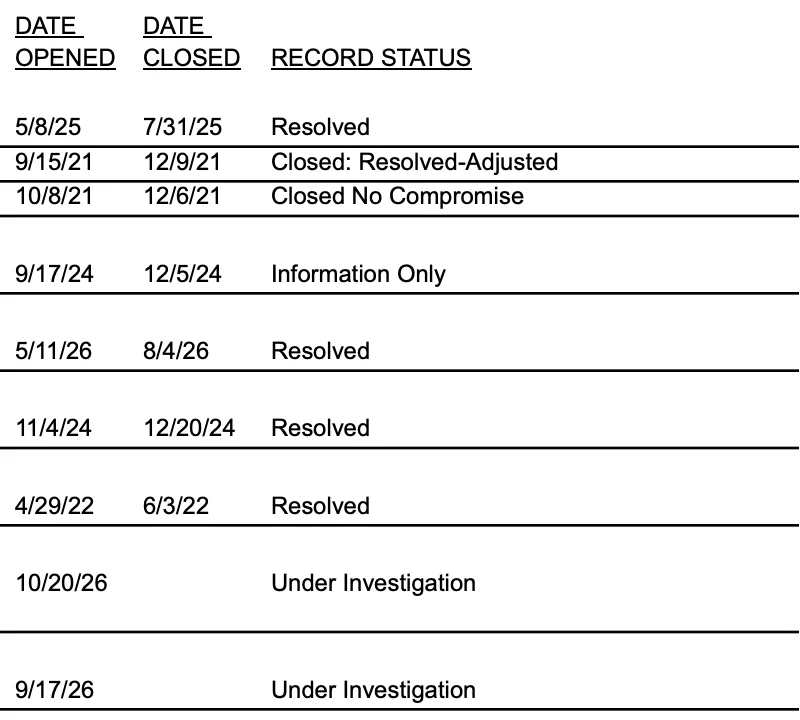 Miami-Dade searches contractors and complaints by name or license number (Miami-Dade contractor search). I don't name any business from these records here.
A complaint proves nothing on its own, so read the outcome and the date; a large company picks up records over the years.
How I Put This Together
I opened every source myself; the dates are in Sources. The numbers come from USD.org data: DBPR registries and discipline lists loaded October 2, 2026, matched against 82 companies listed as plumbers around St. Petersburg on October 9, and recounted on November 12 and 13. Nobody paid for anything here, we don't sell contractor services, and we don't take or forward complaints. I'm not a lawyer; with real money at stake, deadlines matter, so talk to a Florida attorney early.
FAQ
Can I complain about a contractor anonymously?
DBPR can investigate an anonymous written complaint under the conditions above, and FDACS and the FTC accept anonymous reports. The county offices I checked make your complaint public with your name.
Will the contractor see my complaint?
Usually, yes: DBPR as a rule sends a copy, and Miami-Dade and Pinellas can too. Plan as if the contractor will read it.
Will DBPR get my money back?
Not directly. The board can order restitution, but DBPR doesn't represent you or collect it. The money paths are in Getting Your Money Back.
How do I find out whether complaints exist against a contractor?
Check "View License Complaint" in the DBPR record, the Pinellas complaint history, and DBPR's yearly discipline files. An empty record isn't proof, because confidential cases stay closed.
What if the contractor was never licensed?
Report it to DBPR at (866) 532-1440 or online, and to the county board; the complaint is public from the start. The contractor can't enforce the contract or put a lien on your home, and the Recovery Fund won't pay.
This article is general information about Florida law, not legal advice. Laws and agency practices change. For a decision about your own project or dispute, check the current law or talk to a Florida-licensed attorney.
If you spot an error, especially if you're a licensed contractor or a Florida attorney, write to [email protected], and I'll check it and correct the article.
Sources
Each source is listed with the date it was last checked. All pages were opened by the author; dates are re-checked before submission.
- USD.org data: DBPR license registries loaded October 2, 2026; 82 companies listed as plumbers around St. Petersburg matched on October 9, 2026; DBPR yearly discipline lists (licensed, unlicensed activity, Recovery Fund) for fiscal years 2021/22 through 2025/26 recounted November 12 and 13, 2026.
- Florida Statutes, opened November 12 and 13, 2026: F.S. 119.01, F.S. 440.107, F.S. 455.2235, F.S. 455.225, F.S. 489.105, F.S. 489.126, F.S. 489.127, F.S. 489.128, F.S. 489.129, F.S. 489.141, F.S. 489.143, F.S. 501.021, F.S. 501.025, F.S. 501.160, F.S. 501.204, F.S. 558.004, F.S. 570.544, F.S. 713.02, F.S. 713.06, F.S. 713.08, F.S. 713.22, F.S. 837.06.
- Florida Rule, opened November 12, 2026: Rule 61G4-22.001, CILB violations designated for mediation.
- Florida Small Claims Rules, edition of July 1, 2026, Rule 7.010(b), opened November 12, 2026.
- Florida DBPR, opened November 12 and 13, 2026: file a complaint, Division of Regulation, complaints, alternative dispute resolution, Verify a Licensee, unlicensed activity program, Construction Industry Public Records and yearly discipline lists.
- Florida Attorney General, opened November 12, 2026: how to protect yourself, contractors, file a complaint.
- Florida Department of Agriculture and Consumer Services, opened November 12, 2026: file a complaint, Division of Consumer Services, complaints portal, complaint submission confirmation.
- Federal rules, opened November 12 and 13, 2026: federal cooling-off rule for sales made at homes or at certain other locations, 16 CFR 429, and the right of rescission for loans secured by a principal residence, 12 CFR 1026.23 (eCFR; exceptions in 1026.23(f)).
- Pinellas County, opened November 12 and 13, 2026: submit a complaint against a contractor, PCCLB complaint instruction and form, PDF, June 2024, consumer protection office, find a business complaint history.
- Hillsborough County, opened November 12, 2026: search consumer complaints.
- Miami-Dade County, opened November 12, 2026: contractor complaints, contractor inquiry and complaint search.
- Palm Beach County, opened November 12, 2026: contractor complaint form, PDF, May 2025.
- Florida Department of Financial Services, opened November 12, 2026: compliance stop-work order database.
- The Florida Bar, Lawyer Referral Service, described in the PCCLB form: lawyer referral service.